

 简体中文
 English
 日本語
 한국어
 Español
 русский
No. 196, Lifa Avenue, Haian City, Nantong, Jiangsu Province, China

News Category
Product Category
What Is Tool Stacking on a CNC Tube Bender? Multi-Stack Dies Explained
Imagine a production order for one hundred frame brackets. The part requires three bend radii on the same tube, and two of those radii are in different planes. On a conventional single-die CNC bender, the operator would stop after the first radius, remove the bend die, mount the next one, check alignment, and bend a trial part. The same interruption would happen before the final radius. Tool stacking removes most of that pattern by placing several complete bending tool sets on one CNC head, one above another. The machine selects the correct radius by shifting the head, and the tube stays clamped in the collet for the entire sequence.
Tool stacking is therefore both a physical arrangement of dies and a programming strategy. It exists because many real-world parts need more than one bend radius, and because changeover time is one of the biggest cost drivers in tube bending. When the machine can shift between tool levels automatically, the part can move through the whole radius sequence without being released. That single difference has a direct effect on cycle time, part accuracy, and operator workload.
To understand this concept fully, it helps to review what CNC bending involves at the axis level. The rest of this article explains the tooling components, the machine requirements, and the production situations where stacking pays off.
Content
- 1 What exactly is stacked tooling on a CNC tube bender?
- 2 How the CNC head picks the correct tool level
- 3 Why fabricators use tool stacking
- 4 Stacked tooling versus quick-change tooling
- 5 When stacked tooling makes the most sense
- 6 Limitations and risks to plan for
- 7 What to check before choosing a machine
What exactly is stacked tooling on a CNC tube bender?
Stacked tooling means that two or more bend die sets share a common mounting area on the machine head. Each set is a complete combination for one bend radius and includes the bend die, the clamp die, the pressure die and, when needed, the wiper die. These components are mounted at different vertical levels. During a bend sequence, the CNC system raises or lowers the head to bring the correct level into the bending plane.
The simplest version is a single-stack die, where several grooves share one bend-die block. This works when the radii are close and the tube does not need different clamping positions. The more capable version is a multi-stack arrangement with fully independent tool sets for each radius. This is what most manufacturers mean when they discuss tool stacking on a CNC tube bender.
| Tool | Role in a single-radius set | What stacking changes |
|---|---|---|
| Bend die | Defines the inside radius of the bend | Each stacked level carries its own radius |
| Clamp die | Grips the tube against the bend die so it cannot slip | A separate clamp jaw closes at each level |
| Pressure die | Supports the straight tube on the other side of the bend | Moves with the head to the active level |
| Wiper die | Prevents wrinkles on the inside of thin-wall bends | Used only on levels where wall thickness demands it |
Machines designed for this duty have a reinforced head, a servo-controlled vertical axis, and enough throat space to clear the stacked tools. Without those features, adding stack levels would reduce stiffness and hurt tolerance. That is why product families with two-stack, three-stack, and multi-stack tool configurations are not just about taller dies; they are designed around the weight and travel of the stacked head.
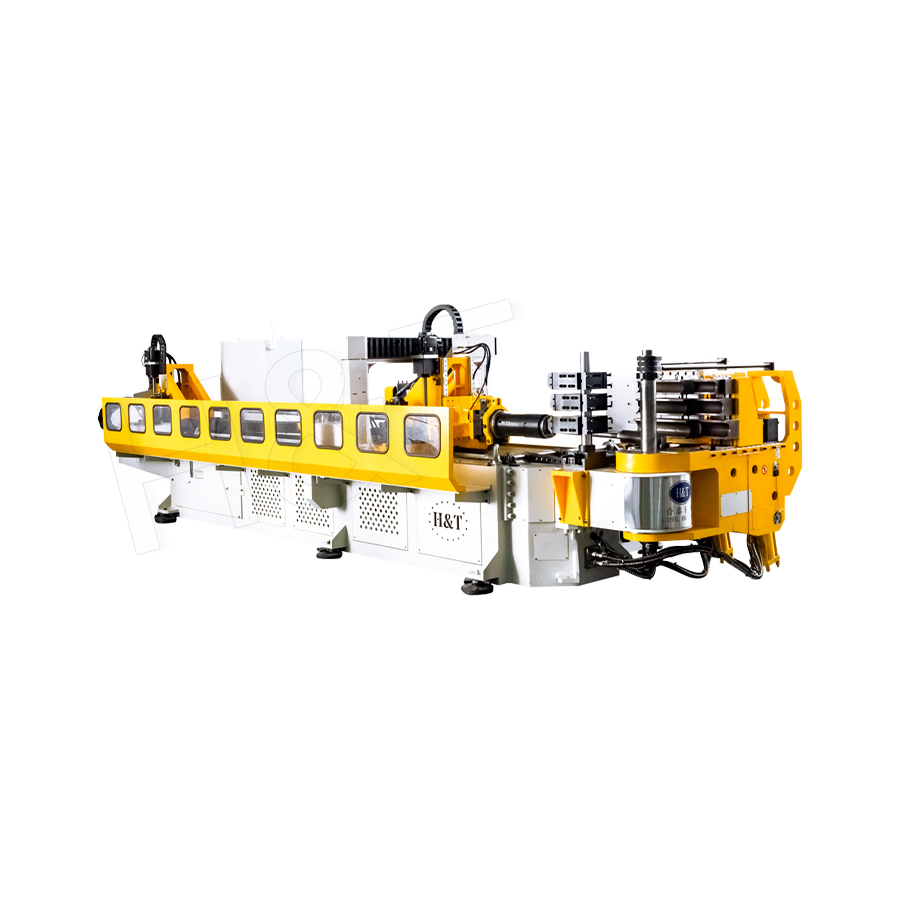 Double-Stack and Multi-Stack Die Tube Bending MachineThis machine uses stacked dies to handle multiple bends or radii in one setup, reducing die changes and supporting large bending angles up to 190°. Ideal for complex pipe shapes requiring close bend spacing.View Product →
Straight stacks and offset stacks
Stacked tools do not always line up over the same bend center. A straight stack keeps all tool centerlines in a vertical line. An offset stack, sometimes called a dog-leg stack, places each radius at a different horizontal position as well as a different height. The offset arrangement allows closely spaced bends along the tube and reduces interference with previously bent sections. Both layouts use the same CNC shifting principle; the difference lies in the geometry of the tool holder and the way the bend planes are programmed.
How the CNC head picks the correct tool level
During programming, each bend is assigned a tool level in addition to its bend angle, rotation angle, and feed distance. Before a bend starts, the machine confirms the current level and shifts if necessary. Because the tube remains in the collet, the bend planes stay mathematically linked to the previous bends. This is a major departure from manual changeover, where each new setup introduces a fresh reference error.
The chart shows typical setup times for a radius change. The values are illustrative for medium-size tubes between 12 and 60 mm in diameter. Manual single-die work includes time for lifting the die, cleaning the mounting face, and aligning the new tool. Stacked tooling shortens the task to a servo move and one verification bend. Quick-change tooling is fast but still requires a physical swap of the whole carrier. Multi-stack machines automate the selection further by moving one of several prepared stations into the bending position. The real saving is not the minutes themselves; it is the reduction in trial parts and the lower risk of operator judgment affecting quality.
Why fabricators use tool stacking
The main benefits of stacked tooling are easier to see in production numbers than in the tooling itself. A stacked head reduces the number of times an operator has to open the machine door. It also keeps the tube clamped for multiple bend operations, which removes the classic problem of losing datum position after remounting. The following points summarize the practical advantages in a shop environment.
- Fewer changeovers, especially when the same two or three radii repeat across many parts.
- Better repeatability, because the alignment between bend die and clamp die is fixed by the tool stack and not by the operator.
- Shorter overall cycle time for multi-radius parts, since the head shift takes seconds.
- Lower scrap during setup, because the first trial part rarely needs rework.
- Less skilled labor for tool changes, which matters in shifts with limited supervision.
The line chart shows how throughput grows as batch size increases. Single-stack tooling spends a large part of every shift on changeovers, so output rises slowly until batches become long. Stacked tooling reduces that penalty because a radius change is only a vertical head shift. Multi-stack machines add another layer of automation by carrying more complete tool sets in the same cycle. For high-mix production, the gap on the left side of the chart matters more than the upper-right values. That is why many job shops choose stacking even when their average order is only 50 or 100 parts.
Stacked tooling versus quick-change tooling
One common alternative to stacking is quick-change tooling, where each bend die is mounted on a carrier and the whole carrier is swapped in a few minutes. Quick-change is attractive when parts use a wide mixture of radii and stock changes constantly. Stacking is better when the same two or three radii appear in nearly every job. The radar chart compares both approaches across six practical criteria. A larger area on any axis means a better score for that criterion.
The radar chart makes one point very clear: the best tooling method depends on how repeatable your part family is. Stacked tooling scores high on setup speed, repeatability, and the ability to handle complex parts. Quick-change tooling wins on flexibility for a constantly changing mix of radii. Tool cost behaves differently in each setup, because stacked tooling needs a full die set per radius while quick-change can share carriers. If your production schedule is stable for months, stacked tooling gives a better overall balance. If you never know what radius will arrive next week, quick-change is the safer route.
| Criterion | Stacked tooling | Quick-change tooling |
|---|---|---|
| Setup speed during a batch | Very fast, controlled by CNC | Fast but still a physical swap |
| Repeatability | High, alignment fixed by machine | Depends on carrier condition |
| Tool cost for each extra radius | Higher, because the full set is needed | Moderate, carriers can be reused |
| Flexibility with new radii | Limited by stack height | High, many carriers can be stored |
| Best fit | Repeated family parts | Job-shop work with frequent changes |
When stacked tooling makes the most sense
Stacked tooling pays off in a specific mix of conditions. The part family must be stable enough to justify buying several complete die sets. The batches should be large enough to benefit from faster changeover but not so large that setup time becomes irrelevant. The geometry should include two or more radii that repeat from one job to the next. Production schedules should also tolerate a short initial engineering effort, because the stack sequence has to be programmed and proven on the first article.
- Automotive exhaust and frame components with multiple curves on one tube.
- Handrails, grab bars, and architectural parts with repeated radius blends.
- Hydraulic and pneumatic tube assemblies that need several bend radii in one length.
- Heat exchanger coils and fluid circuits where the same tube profile runs in high volume.
- Furniture frames and structural parts with visible bend quality requirements.
Some CNC benders use a right-left common sides layout, where one head can work from either side of the center tool position. This layout also uses stacked tools and is useful for parts with bends on opposite sides of the center plane.
 Single-Head Right-Left Common Sides CNC BenderThis five-model series bends from either side of the center tool position, offering servo-driven precision and stored programs for repeatable batch production. Useful for parts with bends on opposite sides of the center plane.View Product →
Limitations and risks to plan for
Stacking is not a free option. The machine throat and the bearing structure limit how many levels can be stacked before stiffness drops. Each extra radius means an additional bend die, clamp die, pressure die, and often a wiper die, so the cost grows quickly with the number of levels. The tool stack also creates new interference risks between the dies and previously bent sections. Maintenance access is tighter, because the head carries more mass and the alignment surfaces are harder to inspect. The practical answer is to involve the machine builder in the part review before finalizing the tool design.
One quantitative argument for stacked tooling comes from process capability. The column chart below compares the capability index for bend angle on a moderately complex part. A higher value means fewer bends outside the tolerance band.
The column chart compares typical process capability for the final bend angle. A Cp of 1.0 allows about 0.27 percent of bends to fall outside the tolerance band. Many automotive and hydraulic customers require a minimum Cp of 1.33. Stacked tooling often reaches the 1.67 level because the tool alignment is fixed by the machine structure. Quick-change tooling is more consistent than a manual single die, but its locating surfaces can wear and need inspection. The takeaway is that stacking improves not only speed but also long-term stability.
What to check before choosing a machine
Every CNC bender that advertises stacked tooling is not the same. Some heads can carry two levels with small tubes only; others are designed for three or more levels and heavy die stacks. The machine software must also support the stack sequence, including tool-level selection in the middle of a bend program. Ask for a sample-part simulation and a written statement of maximum stack height. Service access to the pressure die holder and the wiper die area is worth checking when the machine is under power.
- Number of stack levels supported by the head casting and drive system.
- Vertical travel range and positioning repeatability of the stack axis.
- Clamping force available at each level, especially for heavy wall tubes.
- Tool interface type and compatibility with existing dies in your tool crib.
- Software support for level selection, collision checking, and first-article verification.
For parts with bends in several planes, a double-head 3D full-servo bender extends the same logic even further. Two heads can work on opposite ends of the tube, and the servo-controlled rotations allow overlapping sequences in one cycle.
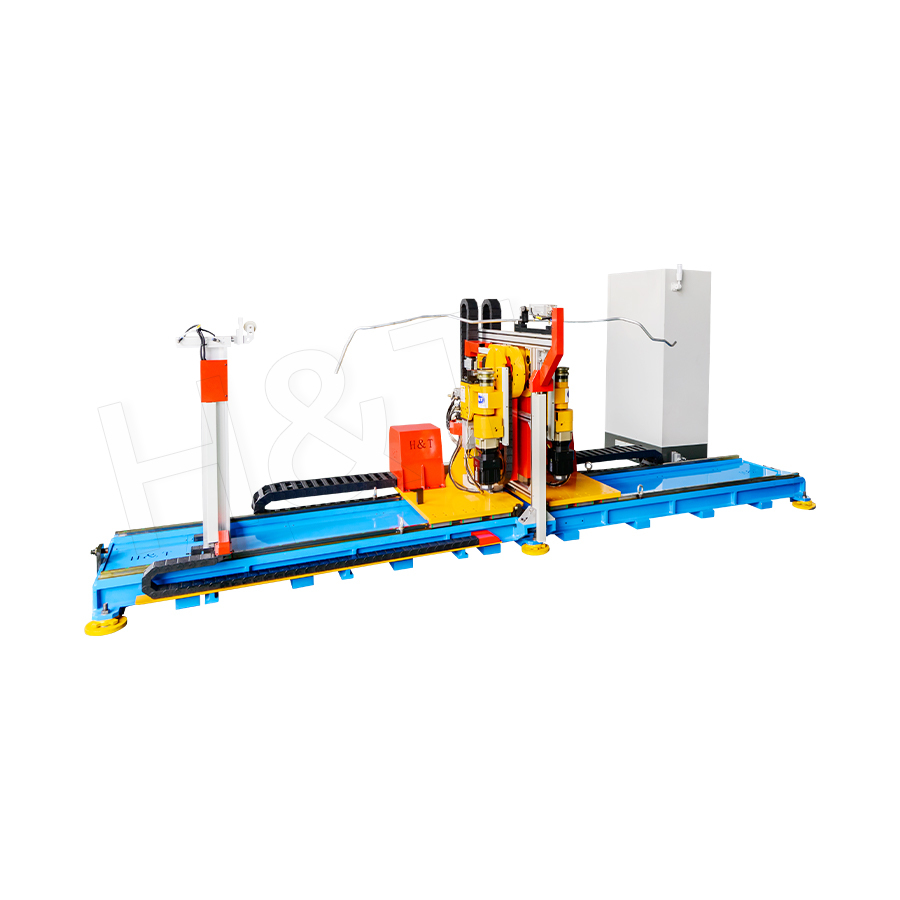 3D Double-Head Full-Servo Tube Bending MachineThis all-electric bender works both tube ends simultaneously in one cycle, supporting pipes up to 180 mm and up to 300 bend points. Suitable for long, fine pipes in automotive, machinery, and air conditioning applications.View Product →
Once the machine specification is clear, compare the total cost of the tool package, not just the base price. A two-level stack on every station can cost as much as a small quick-change system. The decision should be based on your actual part mix and the batch sizes recorded over the last six months.
The short answer to the question is that tool stacking on a CNC tube bender is a way of carrying two or more complete bend tool sets on the same head and selecting them by program. The benefit is the ability to make multiple radii in a single clamping without operator intervention. The value comes from fewer changeovers, better repeatability, and higher output per shift. The best choice depends on your part family, batch sizes, and tolerance requirements. When you compare CNC bending machines, ask how many stack levels the head can carry and how the stack is serviced. That answer tells you whether the machine is built for the kind of work you actually run.
Featured Products
A Complete Range of Tube Processing Solutions
Precision Tube Bending
 Ready To Customise
Your Bent Tube Products?

Ready To Customise Your Bent Tube Products?
Proprietary software, smart control systems, and 50+ patents ensure more efficient and intelligent production at every step.
Copyright © 2025 by Gipfel Precision Machinery Co.,Ltd All Rights Reserved. Privacy Precision Tube Machinery Manufacturer | Pipe Forming, Cutting, End Forming Solutions
