


 简体中文
简体中文 English
 日本語
日本語 한국어
한국어 Español
 русский


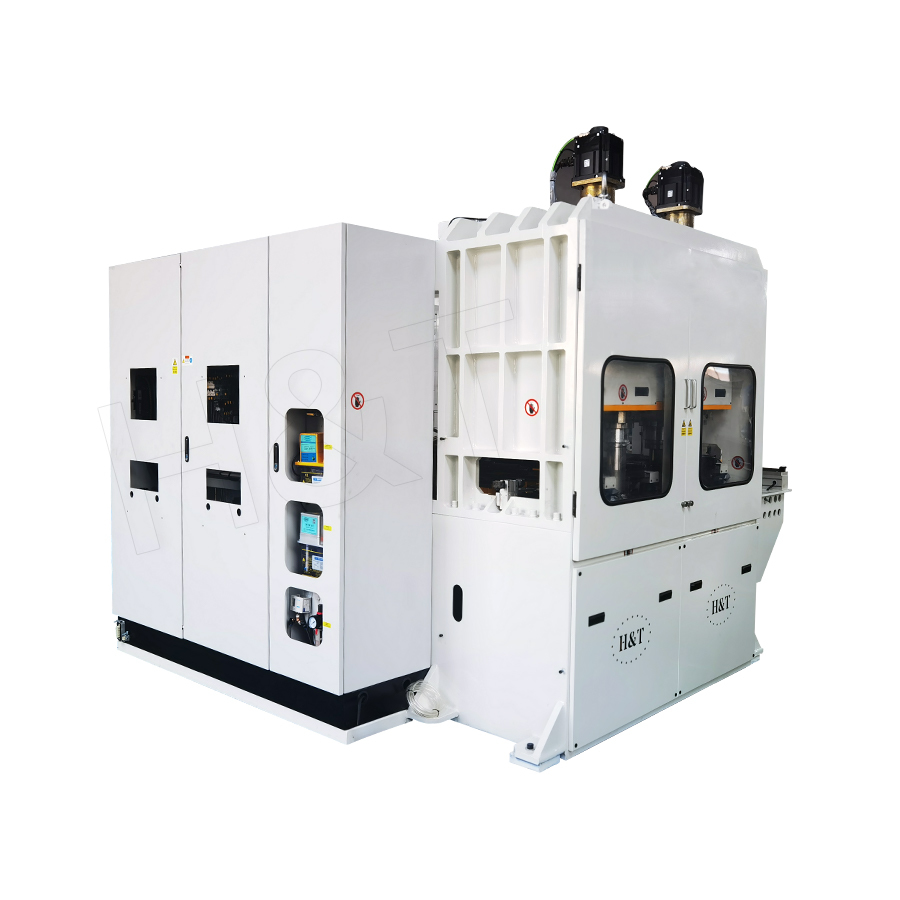
Multi-station Continuous Dies Tube Bending Machine is a CNC-driven pipe processing technology in which a metal tube passes through two or more independent bending stations in a single feeding cycle, with each station equipped with its own bending die, pressure roller, or pressure plate. Unlike conventional single-station bending—where the operator must reposition and re-clamp the tube between every bend—the continuous dies approach allows multiple bends at different angles and planes to be completed in one uninterrupted pass through the machine.
The result is a dramatic reduction in cycle time, clamping error accumulation, and operator intervention. A 6-bend automotive tube assembly that requires 6 separate setups and 5 re-clamping operations on a conventional single-station bender can be completed in a single automated feeding cycle on a multi-station continuous dies machine—reducing total processing time by 50–75% while improving dimensional repeatability across all bend positions.
Working Principle: How Multiple Stations Collaborate
The operation of a Multi-station Continuous Dies Tube Bending Machine follows a coordinated sequence across all stations, governed by a central CNC system:
- Automatic feeding and clamping: The tube is loaded into the machine's automatic feeding device. Fixed guide wheels and adjustable pressure plates grip and center the tube before it enters the first bending station, ensuring precise alignment and eliminating positional variation at the starting point.
- Station 1 bending: As the tube advances to the first programmed bend position, the CNC system activates Station 1's bending die and pressure roller. The die rotates to the target angle—controlled by a servo motor—while the pressure roller maintains contact force to prevent tube wall collapse.
- Continuous feed to subsequent stations: Without releasing the tube, the feeding device advances it to Station 2 (and further stations, if equipped). Each station executes its programmed bend angle, radius, and plane orientation independently and in sequence, all within the same uninterrupted feed cycle.
- Double-layer die forming (optional): On advanced configurations, a double-layer die allows two bends to be formed simultaneously at a single station—one on the upper layer and one on the lower layer—further compressing the number of feeding steps required for complex geometries.
- Automatic unloading: After the final station completes its bend, the finished tube assembly is automatically discharged from the machine. The next tube can begin feeding immediately, maintaining continuous production throughput.
Key Advantages Over Single-Station Bending
| Performance Factor | Multi-station Continuous Dies | Conventional Single-Station |
|---|---|---|
| Cycle time (6-bend tube) | Single feeding cycle | 6 separate operations |
| Re-clamping operations | 0 | 5 (for 6-bend part) |
| Dimensional error accumulation | Minimal | Compounds with each re-clamp |
| Operator labor per part | Low (monitoring only) | High (repositioning each bend) |
| Throughput (parts/shift) | 3–5× higher | Baseline |
| Surface marking risk | Low (no repeat clamping) | Higher (multiple clamp impressions) |
CNC and Servo Drive Technology
The precision and repeatability of multi-station continuous dies bending depend entirely on the quality of the CNC and servo drive system coordinating all stations simultaneously:
- Independent servo drives per station: Each bending die is driven by its own servo motor with encoder feedback, allowing individual stations to operate at different torques and speeds while the CNC system synchronizes their timing within the feeding cycle. Bend angle repeatability of ±0.1°–±0.2° is achievable across all stations simultaneously.
- Feed axis synchronization: The tube feeding carriage is servo-controlled and synchronized with all bending station axes via the central CNC controller, ensuring the tube arrives at each station's die centerline with positional accuracy of ±0.3 mm.
- Automatic springback compensation: The CNC system stores material-specific springback coefficients for each station independently—accounting for the fact that springback behavior at Station 3 may differ from Station 1 due to accumulated tube deformation upstream.
- Program storage and recall: Complex multi-bend programs can be stored and recalled instantly. Changeover between part numbers is completed in under 10–15 minutes via parameter input, without mechanical retooling of all stations.
Materials and Tube Specifications
Multi-station continuous dies machines are engineered to handle a broad range of metallic tube materials, with tooling and process parameters adjusted to each material's forming characteristics:
- Stainless steel (304, 316L): High work-hardening rate requires careful springback compensation at each station. Tooling surfaces are polished or PVD-coated to prevent galling on the tube's outer surface during multi-station clamping.
- Copper and copper alloys: Excellent ductility allows tight multi-radius bending sequences. Used extensively for refrigeration and HVAC coil assemblies requiring multiple return bends in a compact footprint.
- Aluminum alloys (6061, 6063): Annealed condition preferred for multi-bend sequences to avoid inter-station cracking. Post-bending artificial aging can restore T6 mechanical properties.
- Carbon steel and HSLA steel: Standard for automotive and industrial applications. Higher forming forces require heavier station frames and larger servo drives.
Typical machine capacity ranges: tube ODs from Ø6 mm to Ø76 mm, wall thicknesses from 0.5 mm to 6 mm, with 2 to 12 bending stations depending on machine configuration and part complexity.
Industry Applications
Automotive Brake, Fuel, and Cooling Systems
Multi-bend automotive tube assemblies—brake lines, fuel rails, transmission cooling circuits, and air conditioning refrigerant lines—are ideal applications for multi-station continuous dies bending. A typical brake line assembly requires 8–14 bends in multiple planes; completing these in a single machine pass eliminates the error-stacking that occurs when repositioning the tube 13 separate times on a single-station machine.
Aviation and Aerospace Hydraulic Lines
Aircraft hydraulic and fuel lines are routed through confined spaces with complex 3D paths requiring precise multi-radius bending. Multi-station machines with CNC-programmable bend planes enable the production of these intricate geometries with the dimensional traceability required by AS9100 certification—each bend's actual parameters are logged automatically against the part serial number.
Oil and Gas Pipeline Components
Instrumentation tubes, hydraulic control lines, and process pipeline assemblies in oil and gas facilities require complex multi-bend geometries routed around structural obstructions. The wrinkle-free bending quality achieved by the continuous clamping approach—without intermediate release of tube tension—is critical for high-pressure service integrity.
Furniture and Decorative Metalwork
Chair frames, table bases, display racks, and architectural railings requiring multiple bends in a single tube component are efficiently produced on multi-station machines. The absence of re-clamping marks on the tube surface is particularly important for decorative applications where surface finish quality is visible.
Common Questions About Multi-station Continuous Dies Tube Bending Machine
How many bending stations are typically used, and what determines this number?
Most production machines are configured with 2–8 stations, though specialized machines for high-complexity parts can have 12 or more. The number of stations is determined by the maximum number of bends in a single part, the minimum straight-tangent length between successive bends (which determines station spacing), and the available machine footprint. For parts where successive bends are very close together, double-layer die technology at a single station may substitute for adding a physical station.
Can different bend radii be achieved at different stations?
Yes. Each station is equipped with its own independent bending die, so each station can have a different bend radius. This allows a single machine pass to produce parts with multiple different radii—for example, a tight-radius U-bend at Station 1 (R/D = 1.5) and a gentler sweep bend at Station 3 (R/D = 4.0)—without any tooling change or tube repositioning.
What is the minimum straight-tangent distance required between two successive bends?
The minimum straight tangent between bends processed at adjacent stations is determined by the physical clearance required between the downstream station's die set and the upstream station's bending arm at full extension. For most configurations, this minimum is approximately 1.5–2× the tube OD. For parts with shorter inter-bend distances, double-layer dies or specially designed overlapping station configurations are required.
How is tooling changeover managed across all stations simultaneously?
Quick-change tooling systems—where all die components are mounted on standardized holders with indexed locking mechanisms—allow an experienced setup technician to change tooling on all stations in 30–90 minutes depending on the number of stations and the complexity of the new part geometry. CNC recipe recall sets all programmed bend parameters automatically after tooling exchange, minimizing trial-bend scrap during setup.