

 简体中文
简体中文 English
 日本語
日本語 한국어
한국어 Español
 русский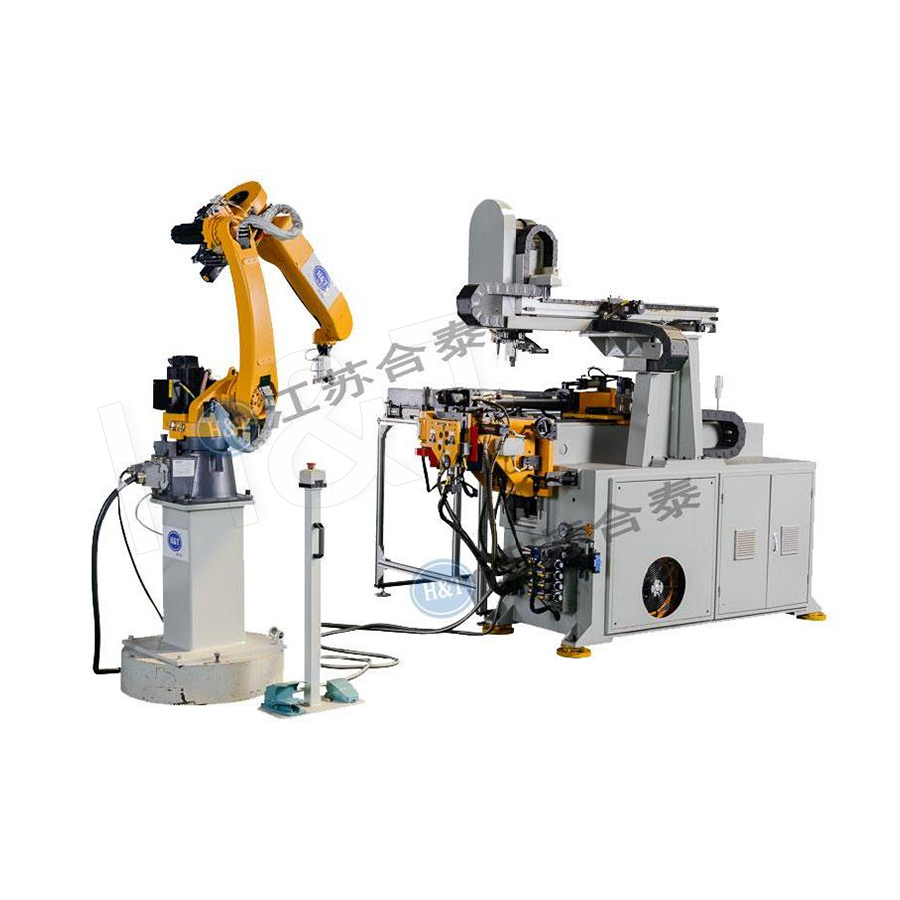
No. 196, Lifa Avenue, Haian City, Nantong, Jiangsu Province, China

News Category
Product Category
What are the characteristics of Robot tube Bending?
Robot tube bending is defined by six core characteristics that distinguish it from conventional manual or semi-automatic tube bending: high precision and repeatability, full automation across the entire tube handling cycle, multi-axis flexibility for complex geometries, rapid product changeover capability, multi-mold parallel processing, and seamless integration with upstream and downstream production systems. Together, these characteristics make robot tube bending the most capable and productive approach to tube forming available in modern manufacturing.
Each of these characteristics emerges from the fundamental nature of the system: an industrial robot — typically a 6-axis articulated arm — is deeply integrated with a CNC tube bending machine to form a unified automated cell. The robot handles all physical tube manipulation (feeding, gripping, positioning, and unloading), while the CNC machine executes the precision bending operations using preset dies. The result is a system that outperforms human operators on accuracy, speed, consistency, and geometric complexity, while eliminating the operator safety risks associated with manual tube bending operations.
Content
- 1 Characteristic 1: High Precision and Dimensional Repeatability
- 2 Characteristic 2: Full Automation of the Complete Tube Handling Cycle
- 3 Characteristic 3: Multi-Axis Flexibility for Complex Three-Dimensional Geometries
- 4 Characteristic 4: Rapid Changeover and Multi-Product Flexibility
- 5 Characteristic 5: Multi-Mold Parallel Installation and Simultaneous Bending
- 6 Characteristic 6: Continuous High-Speed Production Capability
- 7 Characteristic 7: Integration Capability With Upstream and Downstream Systems
- 8 Characteristic 8: Intelligent Programming and Adaptive Process Control
- 9 Characteristic 9: Enhanced Operator Safety and Reduced Physical Demands
- 10 Summary: How the Characteristics of Robot Tube Bending Compare to Alternative Methods
- 11 Practical Implications: Which Characteristics Matter Most in Different Applications
Characteristic 1: High Precision and Dimensional Repeatability
Precision is the foundational characteristic of robot tube bending and the primary reason industries with demanding dimensional requirements — automotive, aerospace, medical, and hydraulic systems manufacturing — have adopted it so broadly. Precision in a robot bending system operates at two levels: the accuracy of the robot's positioning motions, and the accuracy of the CNC bending machine's forming operations.
Robot Positioning Accuracy
Industrial robots used in tube bending applications repeat programmed positions with a repeatability of ±0.02 mm to ±0.05 mm (ISO 9283 standard) — a level of positional consistency that human operators cannot approach, particularly after hours of continuous work. This repeatability means that every tube is presented to the bending machine toolset at the same position and orientation, eliminating the positioning variation that is one of the primary sources of dimensional error in manually loaded bending operations.
CNC Bending Machine Accuracy
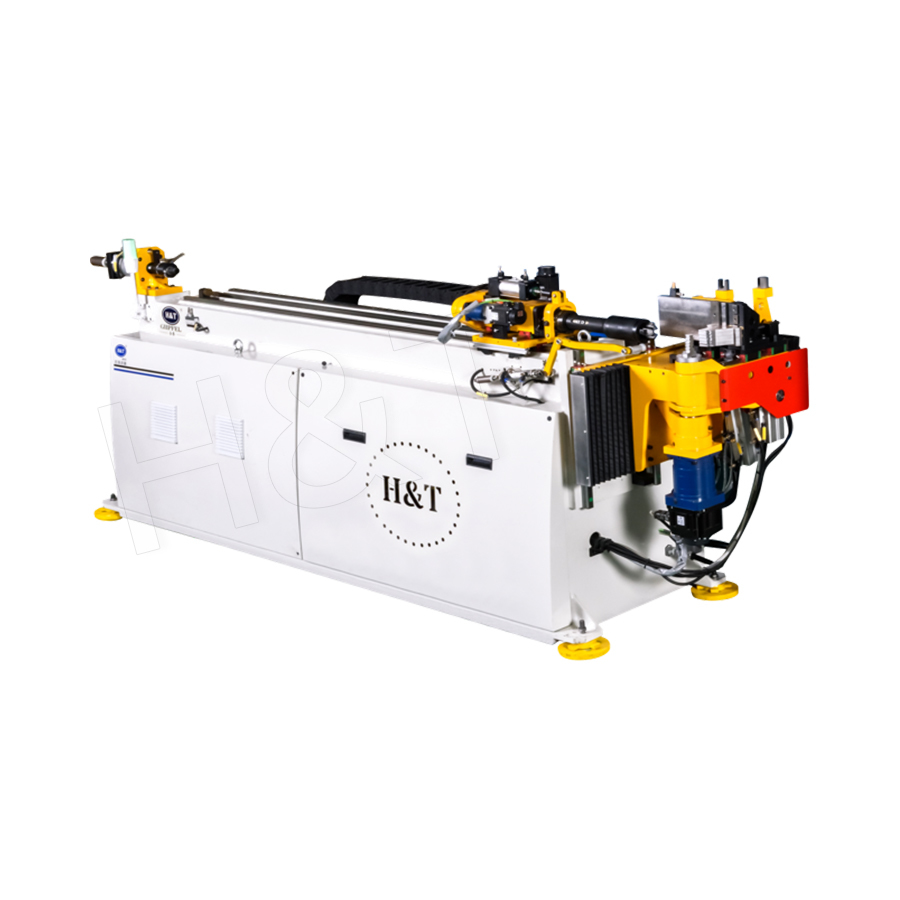
The CNC bending machine controls the three primary bending axes — Y (tube feed length), B (bend angle), and C (tube rotation) — with servo-driven precision. Modern CNC tube benders achieve bend angle accuracy of ±0.1°, feed length accuracy of ±0.2 mm, and rotational accuracy of ±0.1°. These tight tolerances, combined with springback compensation algorithms that pre-correct the programmed bend angle for each material and geometry, allow finished tubes to meet dimensional specifications that are essentially unachievable by manual methods.
Part-to-Part Consistency Over Long Production Runs
Perhaps more important than peak accuracy is the system's ability to maintain that accuracy consistently across thousands of parts and multiple shifts. Unlike human operators whose performance varies with fatigue, attention, and skill level, the robot bending cell produces the 10,000th part of a run with the same dimensional accuracy as the 10th. Scrap rates in robot bending cells typically fall below 0.5% compared to 3–8% for complex parts in manual or semi-automatic operations — a consistency advantage that translates directly into material savings and downstream assembly reliability.
Characteristic 2: Full Automation of the Complete Tube Handling Cycle
A defining characteristic that distinguishes robot tube bending from conventional CNC tube bending is the automation of the complete tube handling cycle — not just the bending motion itself, but every material handling step from raw tube pickup to finished part placement. This complete cycle automation is what enables unattended and lights-out manufacturing operation.
Automated Feeding and Loading
The robot picks individual tube blanks from an input conveyor, bundle rack, or magazine system and loads them into the bending machine without human assistance. Sensor systems confirm tube position and orientation before gripping, allowing the robot to adapt to minor variations in feed position without stopping. This automated loading eliminates the most time-consuming manual task in conventional tube bending — loading, aligning, and clamping each tube blank by hand — and enables the system to operate continuously at its maximum cycle rate.
Automated Inter-Bend Repositioning
Between successive bends, the tube must be advanced by the correct feed length, rotated to the correct angular position, and precisely re-located in the bending machine toolset. In manual bending, this repositioning is performed by the operator — with all the variability and physical effort that implies. In a robot bending cell, the robot or the machine's own CNC-controlled feed axes perform this repositioning automatically, precisely, and in a fraction of the time a manual operator would require.
Automated Unloading and Part Transfer
After the final bend in the program is complete, the robot removes the finished tube assembly from the bending machine and transfers it to the next station — an output conveyor, a part rack, a quality inspection system, or directly to a welding or assembly cell. The ability to integrate this outbound transfer with downstream processes is particularly valuable in Just-in-Time manufacturing environments where the part flow timing between stations directly affects total system throughput. A fully automated robot bending cell can operate for 20 to 30 hours unattended with a sufficiently large tube magazine — enabling overnight lights-out production that multiplies daily output without adding labor.
Characteristic 3: Multi-Axis Flexibility for Complex Three-Dimensional Geometries
The multi-axis flexibility of the industrial robot is the characteristic that most fundamentally differentiates robot tube bending from any other automated bending approach. A 6-axis articulated robot can position and orient its end effector (gripper) at any point within its working envelope with any orientation — a spatial freedom that maps directly onto the ability to handle tubes of any geometric complexity.
Handling Tubes With Multiple Bends in Multiple Planes
As a tube is progressively bent during a multi-bend sequence, the already-bent portions of the tube project into the space around the bending machine. Positioning the tube for each successive bend requires maneuvering the growing bent assembly around the machine's structure, toolset, and work zone without collision. The robot's six axes of freedom allow it to plan and execute collision-free paths through this increasingly complex spatial environment, enabling reliable processing of tubes with 5, 8, 12, or more bends in complex three-dimensional arrangements — geometries that are simply impractical to handle manually with consistent accuracy.
Adjustable Gripping Position Along the Tube
A significant but often-overlooked characteristic of robot tube bending is the robot's ability to grip the tube at different positions along its length for different bends in the same part program. The optimal grip position for bend 1 may be at one end of the tube blank; the optimal position for bend 5 may be much closer to the center, to provide better support and reduce tube deflection under the bending force. The robot can release, reposition, and re-grip the tube — all under program control — providing the ideal support geometry for each individual bend rather than being locked into a single fixed grip position as a mechanical feed axis would be.
Free-Form and Variable-Radius Bending Capability
In push bending or free-form bending configurations, the robot itself becomes part of the bending mechanism — feeding the tube through a moving guide die while controlling the spatial path of the tube's free end. This approach allows the creation of continuously varying radius bends rather than discrete constant-radius bends, and enables complex curved geometries without dedicated form-specific tooling. The robot's smooth, programmable motion trajectory translates directly into smooth, continuously varying tube curvature — a capability unavailable on any fixed-axis bending machine.

Characteristic 4: Rapid Changeover and Multi-Product Flexibility
The ability to quickly change between different tube products — different diameters, wall thicknesses, bending radii, and bend sequences — is a critical characteristic that makes robot tube bending systems economically viable across a wide range of production environments, from high-mix low-volume job shops to high-volume automotive suppliers with frequent model changeovers.
Automatic End-of-Arm Tool (EOAT) Change
When a robot bending cell switches to a different tube diameter, the robot's gripper must be changed to match the new tube size. Automatic tool changers mounted on the robot's wrist — which lock and unlock the EOAT using a pneumatic or electric quick-release mechanism — allow EOAT changes to complete in under 60 seconds without any manual intervention. The system then automatically recalls the corresponding bending program and robot motion program for the new product, and production of the new tube begins within minutes of the changeover command.
CNC Bending Machine Tooling Change
Changing the bending machine toolset — the bend die, pressure die, wiper die, and optional mandrel — when switching between tube diameters or bend radii is a more involved operation, but modern quick-change die mounting systems significantly reduce changeover time compared to traditional tooling. Quick-change toolset installations complete bending machine tooling changes in 10 to 20 minutes compared to 1 to 4 hours for conventional toolset changeouts — enabling a single robot bending cell to process 10, 15, or more different tube part numbers per shift when running in a high-mix production environment.
Program-Based Product Switching Without Physical Setup
When two tube products share compatible tooling (same diameter and bend radius but different bend sequences), switching between them requires only a program recall — no physical tooling change at all. The operator selects the new part program from the HMI, confirms the selection, and the cell immediately begins producing the new part on the next cycle. This zero-setup switching between program-only changes allows very small batch sizes — in theory, even single-piece batches — without the changeover overhead that would make small batches uneconomical on a dedicated tooled machine.
Characteristic 5: Multi-Mold Parallel Installation and Simultaneous Bending
A distinctive characteristic of advanced robot tube bending systems is their support for parallel installation of multiple tooling sets on a single bending machine — allowing the robot to select from different die sets and execute multiple bending shapes within a single production cycle without stopping for tooling changes.
Multi-Stack Tooling on a Single Machine
Tube bending machines designed for multi-mold operation can accommodate multiple sets of bend dies, pressure dies, and wiper dies mounted simultaneously in a tooling stack or carousel. Each toolset in the stack corresponds to a different bend radius or tube diameter. The CNC system selects the appropriate toolset for each bend within the part program by indexing the tooling stack to the correct position before the bending operation begins. This multi-stack capability means that a tube requiring bends at two different radii — for example, a complex automotive brake line with tight-radius bends near connectors and larger-radius sweeping bends through the body — can be completed in a single fixture, single-program cycle without any mid-cycle tooling change.
Parallel Processing for Higher Throughput
In cell configurations where the robot services multiple bending machines simultaneously, the robot can load a tube into machine 1, initiate its bending cycle, then transfer to machine 2 to load and initiate another part's bending cycle, while machine 1 continues bending autonomously. This parallel machine servicing — sometimes called robot wrist utilization optimization — increases overall cell throughput by keeping all machines in the cell continuously active rather than waiting idle for the robot to complete its previous transfer. A robot servicing two bending machines in this way can achieve effective throughput approaching the combined capacity of both machines operating independently with their own dedicated operators.
Characteristic 6: Continuous High-Speed Production Capability
Robot tube bending systems are characterized by their ability to sustain high production rates continuously without the breaks, shift changes, fatigue effects, and pace variation that affect human-operated systems. This continuous production characteristic is a major driver of the economic case for robot bending automation, particularly in high-volume manufacturing environments.
Key aspects of the continuous production characteristic include:
- Consistent cycle time from first to last part: The robot and CNC machine execute each cycle in the same programmed time, regardless of time of day, shift duration, or operator experience. Where a manual operator might complete an early-shift bend in 25 seconds but slow to 35 seconds late in the shift due to fatigue, the robot consistently executes the same cycle in, for example, 22 seconds throughout a 24-hour production period.
- Three-shift and lights-out operation: A robot bending cell can run three shifts per day with a single operator responsible for raw material replenishment and finished part removal across all three shifts — compared to three dedicated operators per shift for a manually operated machine. This 3× effective machine utilization at a fraction of the labor cost is one of the most compelling economic characteristics of robot tube bending.
- Typical cycle times: Depending on tube geometry complexity, material, and number of bends, robot tube bending cycle times typically range from 12 to 60 seconds per part — with simple 2-bend automotive tubes at the low end and complex 10+ bend assemblies at the higher end. Even at 60 seconds per part, continuous 24-hour operation produces 1,440 parts per day from a single cell.
- Predictable OEE (Overall Equipment Effectiveness): With planned maintenance, tool wear monitoring, and adequate raw material supply, robot tube bending cells regularly achieve OEE values of 80% to 90% — significantly higher than the 50–65% OEE typical of manually operated tube bending operations where unplanned stoppages, quality defects, and pace variation reduce effective utilization.
Characteristic 7: Integration Capability With Upstream and Downstream Systems
Robot tube bending cells are not isolated production islands — a defining characteristic is their ability to integrate with upstream material handling systems and downstream processing, inspection, and assembly operations to form complete automated production lines.
Upstream Integration: Material Supply
Robot bending cells integrate with automated tube cutting lines (saw cutting or laser cutting), bundle magazine systems, vibratory bowl feeders for small-diameter tubes, and AGV (Automated Guided Vehicle) material delivery systems. The robot can receive tubes cut to precise lengths by an upstream CNC saw, eliminating the length variation that would occur if tube cutting were done manually and separately. End-to-end integration from coil or bundle stock through cutting and into bending creates a continuous-flow production line with minimal material handling labor and minimal work-in-process inventory between operations.
Downstream Integration: Inspection and Quality Control
The robot transfers finished bent tube assemblies directly to inline 3D laser scanning systems or vision-based inspection stations that verify every part's geometry against the CAD nominal — enabling 100% part inspection rather than statistical sampling. Parts within tolerance proceed automatically to the output conveyor or next station; out-of-tolerance parts are diverted to a reject station with the associated measurement data logged for analysis. The inspection data can be fed back to the bending machine's CNC to implement adaptive corrections that compensate for gradual die wear or material batch variation — a closed-loop quality control characteristic unique to automated bending systems.
Downstream Integration: Assembly and Joining Processes
In advanced manufacturing cells, the robot bending system feeds directly into welding stations, brazing furnaces, flaring and swaging machines, or assembly fixtures — eliminating the part buffering and manual transfer between operations that add time, cost, and handling damage risk. Automotive brake line production, for example, can integrate tube bending, end-forming (flaring and threading), and coil protection application in a single continuous robotic line, delivering a complete finished component directly to the vehicle assembly line.
Characteristic 8: Intelligent Programming and Adaptive Process Control
Modern robot tube bending systems are characterized by sophisticated software intelligence that goes far beyond simply storing and replaying recorded motion programs. Intelligent programming and adaptive control are increasingly defining characteristics of advanced robot bending cells.
Offline Programming From 3D CAD Models
Robot and bending programs are generated automatically from 3D tube design files using specialist CAD/CAM software, without the need to manually program the robot or teach the bending machine through trial-and-error on physical tube samples. The software decomposes the 3D tube geometry into a YBC (feed-bend-rotation) sequence, calculates springback compensation values for the specified material and geometry, generates optimized robot motion paths with collision-free inter-bend repositioning, and simulates the complete sequence virtually before any physical machine time is committed. A new tube program that previously required 2 to 4 hours of machine time for setup and first-article development can now be generated and simulated in 20 to 60 minutes of offline software work, with high confidence in first-article success.
Springback Compensation and Material Adaptation
All metallic tubes spring back elastically after bending — the die releases and the tube angle increases slightly as the elastic strain recovers. Springback magnitude depends on material yield strength, Young's modulus, wall thickness, and bend radius — all of which vary between material batches even for nominally identical specifications. Advanced robot bending systems measure the first few parts of each production batch and automatically adjust the overbend correction in the CNC program to account for the actual springback behavior of the specific material lot, ensuring that production parts consistently meet dimensional specifications regardless of material batch variation.
Real-Time Process Monitoring and Anomaly Detection
Robot bending systems continuously monitor key process parameters — bending force, servo torque, cycle time, robot position error, and tool wear indicators — and compare them against established baseline values. Deviations from baseline trigger alarms that alert operators to developing problems (tool wear, tube feeding errors, material property anomalies) before they produce out-of-tolerance parts. This predictive characteristic shifts maintenance from reactive (fix after failure) to proactive (address before failure), significantly reducing unplanned downtime and scrap generation.
Characteristic 9: Enhanced Operator Safety and Reduced Physical Demands
An often understated but critically important characteristic of robot tube bending is the fundamental improvement in operator safety and working conditions that automation delivers. Manual tube bending is a physically demanding and potentially hazardous operation; robot automation transforms the operator's role from active machine operator to cell supervisor.
- Elimination of crush and entrapment risk: The bending machine's clamping and forming toolset represents a significant crush and entrapment hazard for operators who load and position tubes manually. Robot automation removes the operator's hands from the bending zone — the robot's safety-rated monitoring systems ensure that no human can enter the dangerous zone while the machine is in active operation.
- Elimination of tube handling injuries: Tube ends are sharp; heavy tube bundles cause back and shoulder injuries from repetitive lifting; handling hot tubes from warm-forming operations presents burn risks. Robot automation eliminates direct operator contact with tubes during the bending cycle, removing these injury pathways from the production operation.
- Reduction of repetitive strain injuries: Tube bending operators perform highly repetitive motions — loading, positioning, clamping, and repositioning tubes thousands of times per shift. These repetitive motions are a documented cause of cumulative trauma disorders (CTDs) affecting wrists, shoulders, and lower backs. Robot automation eliminates these repetitive physical demands from the operator's role.
- Safety-rated cell perimeter protection: Robot bending cells are enclosed by safety fencing, light curtains, or area scanner systems that prevent human entry into the robot's working envelope during operation. Interlocked access doors require the robot to enter a safe state before the door can be opened, providing a systematic barrier between the robot's high-speed, high-force motions and human workers.
Summary: How the Characteristics of Robot Tube Bending Compare to Alternative Methods
The following table provides a consolidated comparison of robot tube bending's key characteristics against manual tube bending and conventional CNC tube bending without robot integration, illustrating where robot bending's characteristics deliver meaningful performance advantages.
| Characteristic | Robot Tube Bending | CNC Bending (No Robot) | Manual Tube Bending |
|---|---|---|---|
| Positional repeatability | ±0.02–0.05 mm (robot) + ±0.1° (CNC) | ±0.1° (CNC only); manual load variation | ±1–3° operator-dependent |
| Handling cycle automation | Fully automated — feeding to unloading | Bending only automated; manual load/unload | Fully manual |
| Complex 3D geometry capability | Excellent — 6-axis robot navigates complex shapes | Limited — Y/B/C axes only | Limited by operator skill and fatigue |
| Product changeover time | Minutes (EOAT auto-change) to 20 min (tooling) | 30–120 minutes (manual tooling change) | 30–240 minutes |
| Multi-mold parallel operation | Yes — CNC toolstack selection in-program | Possible with multi-stack machines | No |
| Unattended / lights-out operation | Yes — with adequate tube magazine | No — operator required for loading | No |
| Downstream process integration | Seamless — robot transfers to inspection, assembly | Partial — manual transfer to next operation | Manual transfer only |
| Scrap rate (complex parts) | Below 0.5% | 1–3% | 3–8% |
| Operator safety risk | Low — operator outside active bending zone | Moderate — operator in machine proximity | High — hands in bending zone |
Practical Implications: Which Characteristics Matter Most in Different Applications
Different manufacturing environments value the characteristics of robot tube bending differently depending on their specific production requirements. Understanding which characteristics are most relevant to a given application helps manufacturers prioritize the system features that will deliver the greatest return on their automation investment.
| Application Type | Most Critical Characteristics | Reason |
|---|---|---|
| Automotive high-volume production | Speed, repeatability, lights-out operation | JIT delivery requires high throughput at consistent quality across 3 shifts |
| Aerospace precision components | Precision, repeatability, inspection integration | Tight tolerances and full traceability are non-negotiable regulatory requirements |
| High-mix job shop fabrication | Rapid changeover, multi-product flexibility | Frequent product changes demand fast setup and minimal dedicated tooling investment |
| Complex multi-bend assemblies | Multi-axis flexibility, 3D geometry handling | Complex shapes cannot be reliably produced manually at required precision |
| Hazardous material environments | Operator safety, unattended operation | Removing operators from proximity to hot, sharp, or chemically treated tube material |
Regardless of application type, the foundational characteristics of robot tube bending — precision, repeatability, automation completeness, and geometric flexibility — provide a performance baseline that consistently outperforms all manual and semi-automatic alternatives on the metrics that matter most to modern manufacturing: quality, throughput, and cost per part over a full production lifecycle. These characteristics collectively explain why robot tube bending has become the standard production method in automotive, aerospace, HVAC, and precision engineering tube fabrication worldwide, and why its adoption continues to accelerate as robot technology becomes more capable and accessible to manufacturers of all sizes.
Featured Products
A Complete Range of Tube Processing Solutions
Precision Tube Bending
 Ready To Customise
Your Bent Tube Products?

Ready To Customise Your Bent Tube Products?
Proprietary software, smart control systems, and 50+ patents ensure more efficient and intelligent production at every step.
Copyright © 2025 by Gipfel Precision Machinery Co.,Ltd All Rights Reserved. Privacy Precision Tube Machinery Manufacturer | Pipe Forming, Cutting, End Forming Solutions
