


 简体中文
简体中文 English
 日本語
日本語 한국어
한국어 Español
 русский


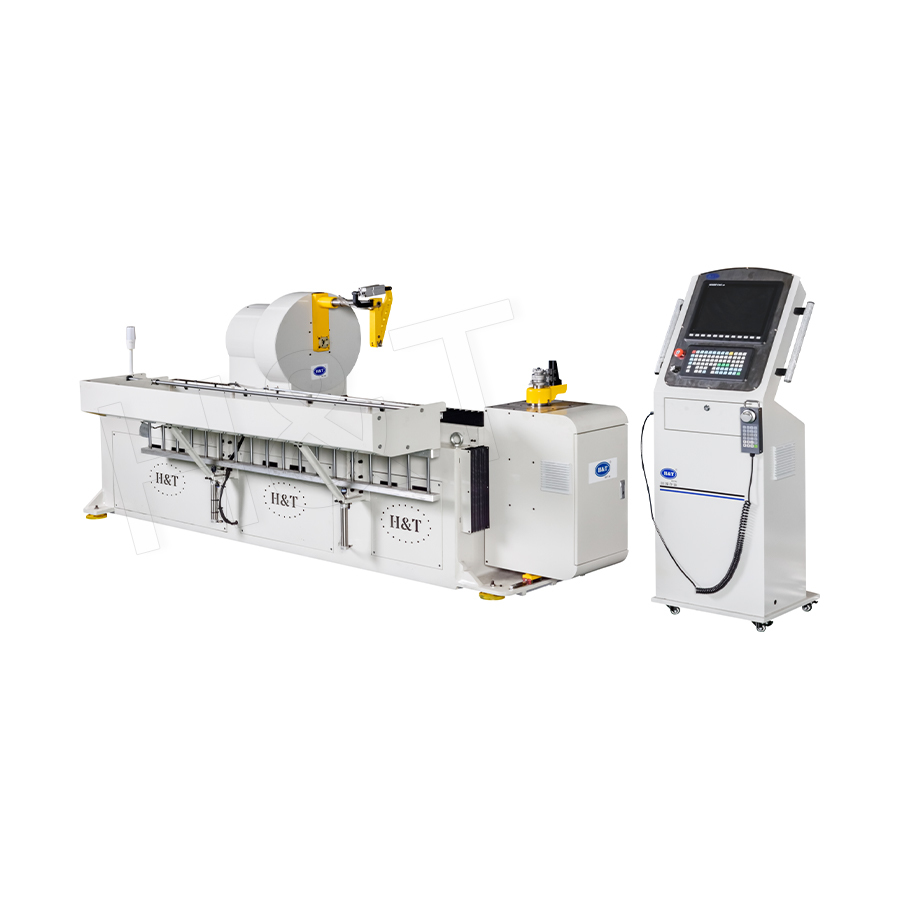
Wire Bending Machine—also referred to as wire forming, steel Wire Bending Machine, or iron wire forming—is an industrial manufacturing process in which metal wire (steel, stainless steel, copper, iron, aluminum, or special alloy wire) is shaped into predefined 2D or 3D configurations by automated or semi-automated bending machines. These machines use servo-driven bending heads, rotating arms, and precision wire-feed mechanisms to produce hooks, rings, brackets, springs, grids, frames, clips, and complex spatial forms from coiled wire stock in high-speed, continuous, and repeatable production cycles.
Wire Bending Machines range from simple 2D cam-driven units for flat wire forms to fully CNC-controlled 3D multi-axis systems capable of producing complex spatial shapes with 360° unrestricted rotation of the bending head. High-end CNC Wire Bending Machines can execute 30–120 bending operations per minute, making them essential in high-volume manufacturing for the automotive, construction, household goods, agricultural, and electronics industries.
How Tube Bending Machine Work
The Tube Bending Machine process involves a sequence of precisely coordinated operations performed by the machine's core mechanical and control systems:
- Wire straightening: Wire fed from a coil reel passes through a multi-roller straightener that removes the coil's residual curvature, delivering a straight, tension-free wire to the bending head. Straightener roller pressure is adjustable for different wire diameters and materials.
- Servo-controlled wire feeding: A servo-driven pinch-roller feed unit advances the wire by precisely programmed increments between bending operations. Feed length accuracy of ±0.1 mm is standard on CNC systems, directly determining the straight-segment lengths of the finished part.
- Bending head operation: The bending head—which holds a bending pin and a pivot tool—rotates by the programmed angle around the wire, forcing it to bend at the contact point. On 2D machines, the head rotates in a fixed plane. On 3D machines, the bending head can also rotate about the wire's longitudinal axis (B-axis), enabling bends in any direction in 3D space.
- Cutting: After the last bend, an integrated cutting unit (flying shear or guillotine cutter) severs the finished part from the wire feed. Cutting is synchronized with the bending sequence by the CNC controller, maintaining precise overall part length.
- Discharge: Finished parts drop into a collection bin or are picked by a robot or conveyor for downstream processing (welding, coating, assembly).
2D Tube Bending Machine vs. 3D Tube Bending Machine
The distinction between 2D and 3D Tube Bending Machine capability is fundamental to machine selection and part design:
| Feature | 2D Tube Bending Machine | 3D Tube Bending Machine |
|---|---|---|
| Bend planes | Single plane only | Multiple planes (360° rotation) |
| Typical parts | Flat clips, flat brackets, rings | 3D hooks, springs, spatial frames, baskets |
| Machine cost | Lower | Higher |
| Programming complexity | Simple (X, Y, angle) | Complex (X, Y, Z, B-axis, angle) |
| Part geometry freedom | Limited to flat forms | Unlimited spatial geometry |
| Speed (typical) | 60–120 bends/min | 30–80 bends/min |
Adjustable Parameters and Control Flexibility
Modern CNC Wire Bending Machines provide comprehensive parameter control, allowing the same machine to handle a wide range of wire diameters, materials, and part geometries without mechanical retooling:
- Bending angle: Programmable from 1° to 360°+ per bending step. Springback compensation factors are stored per material and wire diameter, automatically adjusting the programmed angle to achieve the target geometry after elastic recovery.
- Bending speed: Servo-controlled bending head speed is adjustable from slow (for tight bends on hard materials) to fast (for simple bends on ductile wire). Variable speed within a single part program optimizes cycle time without risking surface marking or cracking.
- Wire feed length: Each feed increment defines the straight-segment length before the next bend. Increments can range from 0.1 mm to several meters in a single part program, accommodating parts from miniature clips to large furniture frames.
- Bending radius: The bending pin diameter determines the inside bend radius. Quick-change pin sets allow radius switching between part programs without extended downtime.
- B-axis rotation (3D machines): The angle of the bending plane relative to the wire axis is programmable per bend step, enabling the successive bends to be oriented in any direction in 3D space.
Integrated Auxiliary Functions
Tube Bending Machine machines are frequently equipped with auxiliary processing units that transform them into complete wire-to-finished-part manufacturing cells, eliminating the need for separate downstream operations:
- Cutting unit: Flying shear or guillotine cutter severs the wire at programmed positions. Cutting force and blade clearance are adjusted for each wire diameter and material to ensure burr-free cut faces.
- Chamfering unit: End-chamfering attachments deburr and bevel the cut wire ends inline, which is critical for safety and assembly quality in components such as medical device frames and food-service wire forms.
- Welding unit: Resistance or laser spot welding modules can join wire ends or cross-wire intersections inline, producing closed-form rings, grids, or basket structures without a separate welding station.
- Embossing and marking: Inline embossing rolls or laser marking units apply part numbers, date codes, or decorative patterns to wire surfaces during the forming cycle, supporting traceability and product differentiation.
- Automatic coiling and stacking: For high-volume production, integrated coiling or stacking units collect finished parts in organized bundles, ready for packaging or downstream coating, without manual handling.
Wire Materials and Diameter Ranges
Tube Bending Machines are available in configurations covering wire diameters from sub-millimeter precision wire to heavy structural wire:
- Carbon steel wire (Q195, Q235, SAE 1006–1065): The most common substrate. Tensile strengths from 350 N/mm² (soft wire) to 1,500 N/mm² (hard-drawn wire) require widely varying bending forces—machine selection must be rated for the hardest material in the production mix.
- Stainless steel wire (302, 304, 316): Higher springback and work-hardening rate than carbon steel. Used in food processing equipment, medical devices, and marine applications. Typically requires 15–25% greater springback over-bend compensation compared to equivalent carbon steel wire.
- Copper and brass wire: Excellent ductility allows tight bends and complex 3D forms. Common in electrical components, decorative items, and heat exchanger fins. Low forming force suits lightweight machine configurations.
- Aluminum wire: Used in packaging, automotive, and aerospace wire forms. Requires polished tooling contact surfaces to prevent surface scratching that could initiate fatigue cracks.
Standard machine capacity ranges: wire diameters from Ø0.3 mm (precision miniature) to Ø20 mm (heavy structural), depending on machine class and frame rating.
Industry Applications
Construction and Reinforcement
Rebar stirrups, concrete reinforcement ties, and structural wire mesh are among the highest-volume Wire Bending Machine applications. Automated 2D Tube Bending Machines produce stirrups in standard sizes (square, rectangular, polygonal) at rates of 1,000–3,000 pieces per hour, far exceeding manual bending productivity and with zero size variation between parts.
Automotive Components
Seat frame springs, headrest supports, trunk lid torsion bars, wiper blade frames, and exhaust hanger hooks are produced on 2D and 3D Tube Bending Machines in automotive Tier-1 and Tier-2 facilities. Complex 3D seat spring assemblies with multiple spatial bends are produced at 15–40 parts per minute on multi-axis CNC wire benders, replacing time-consuming manual forming operations.
Household Goods and Furniture
Shopping cart frames, dish rack baskets, wire shelving, barbecue grill grates, and coat hangers are all produced by Tube Bending Machine. The combination of inline welding and bending on CNC wire forming centers allows complex wire basket structures to be produced from a single wire in one machine cycle, with no manual assembly required.
Medical Devices and Precision Components
Orthopedic fixation wires, surgical retractors, stent frameworks, and precision spring contacts for electronic connectors require dimensional tolerances of ±0.05–±0.1 mm on wire diameters of 0.3–3 mm. CNC 3D Tube Bending Machines with closed-loop position feedback and vision-based inspection achieve these tolerances at rates that manual forming cannot approach.
Common Questions About Wire Bending Machine
What is the maximum bending angle achievable in a single step?
Most Wire Bending Machines can bend up to 180° in a single step, and some specialized heads rotate up to 360° to form complete rings or coils in a single motion. For bends exceeding 180° where the geometry prevents head rotation beyond that point, the wire can be repositioned (B-axis rotation) to approach the remaining angle from the opposite direction.
How is springback managed in Wire Bending Machine?
Springback in Wire Bending Machine depends on wire material, diameter, and temper. The CNC system stores springback correction values per material/diameter combination and automatically over-bends by the compensation amount. For hard-drawn steel wire, springback can be 5°–15° per 90° bend; for annealed copper wire, it is typically under 2°. Regular trial-bend verification when changing wire lots ensures the stored corrections remain accurate.
Can a Wire Bending Machine handle pre-coated or painted wire?
Yes, provided the tooling contact surfaces are polished and the bending parameters (speed, radius) are optimized to minimize surface stress on the coating. PVC-coated wire, galvanized wire, and epoxy-coated wire are all regularly processed on wire benders with appropriate tooling design. However, tight-radius bends on thick-coated wire may cause coating cracking at the bend extrados—a radius of at least 3× wire diameter is recommended for pre-coated wire to maintain coating integrity.