


 简体中文
简体中文 English
 日本語
日本語 한국어
한국어 Español
 русский


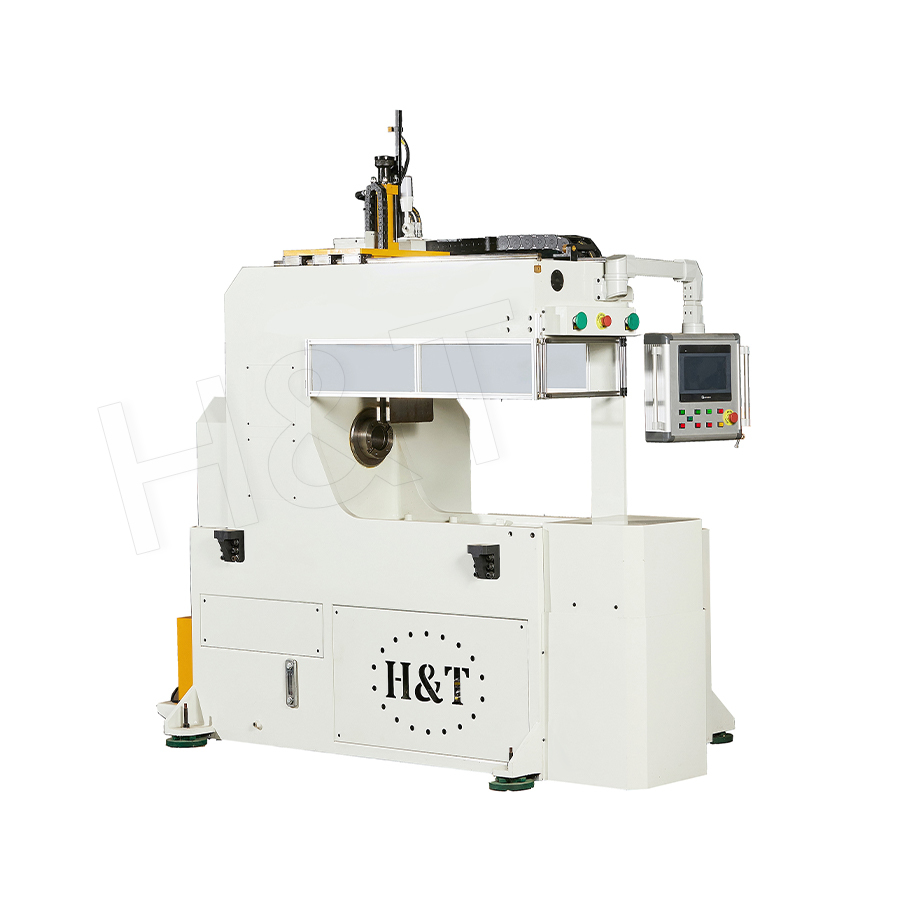
Tube Spiral Coil Bending Machine is a specialized tube forming process in which metal tubing—most commonly copper, carbon steel, or stainless steel—is continuously formed into helical (spiral) coils of precisely controlled diameter, pitch, and turn count using guide rollers, bending rollers, and pitch-setting mechanisms. The resulting spiral coil tube provides a large heat transfer area within a compact footprint, making it the primary functional element in heat exchangers, HVAC fan coil units, and industrial process heating and cooling systems.
A coil bending machine integrates tube feeding, radius-setting rollers, pitch guide mechanisms, and a rotating mandrel or winding head into a single automated system. Depending on configuration, it can produce coils from small-diameter copper tubes (Ø6 mm) for refrigeration applications to large-diameter steel pipes (Ø76 mm+) for industrial heat exchangers, with coil outside diameters ranging from 50 mm to over 2,000 mm and helix pitches from tight (nearly touching turns) to widely spaced configurations.
How a Coil Bending Machine Works
The coil forming process involves a coordinated sequence of tube feeding, radius forming, and pitch control, all managed by the machine's CNC or servo control system:
- Tube feeding: Straight tube sections (or tubes fed from a coil decoiler for soft copper or aluminum) are fed into the machine's guide roller assembly at a controlled rate. The feed speed determines the production rate and influences the quality of the helix.
- Radius-setting rolls: Three or more bending rolls progressively deform the tube into the circular arc of the target coil diameter. The gap between the rolls (particularly the adjustable bending roll) determines the coil radius. CNC servo control allows real-time radius adjustment to produce tapered coils (progressively increasing or decreasing radius) if required by the heat exchanger design.
- Pitch guide mechanism: A pitch-setting guide—typically a motorized lead screw or servo-driven guide rail—advances the tube axially at a controlled rate synchronized with the rotational feed, establishing the coil's helix pitch (the axial distance between adjacent turns). Pitch is programmable and can be varied along the coil length to create non-uniform pitch coils for specific flow distribution requirements.
- Cut-off: After the programmed number of turns is completed, a tube cutter (rotating saw or cold-cut shear) severs the coil at the exit end while maintaining coil geometry. The finished coil is then inspected for coil diameter, pitch, and end preparation quality.
Why Spiral Coil Geometry Excels in Heat Exchange Applications
The spiral coil geometry offers inherent thermodynamic and fluid-dynamic advantages over straight-tube or U-tube heat exchangers:
- Dean vortex effect: Flow through a helically curved tube induces secondary circulation (Dean vortices) that disrupts the boundary layer at the tube wall, significantly increasing the heat transfer coefficient. For the same tube length, a spiral coil achieves 15–40% higher heat transfer performance than an equivalent straight tube due to this secondary flow enhancement.
- Compact footprint: A spiral coil of 10 meters tube length occupies a fraction of the floor space of an equivalent straight-tube arrangement, enabling compact heat exchanger designs for space-constrained installations such as residential HVAC units, industrial boiler water preheaters, and skid-mounted process systems.
- Self-cleaning tendency: The centrifugal force on fluid flowing through the coil pushes particulates and scale toward the outer wall, reducing fouling rates compared to straight-tube designs—a significant operational advantage in water-to-water heat exchangers with hard water supply.
- Thermal expansion absorption: The coil geometry inherently accommodates thermal expansion and contraction through its spring-like structure, eliminating the need for expansion joints and reducing thermal fatigue stress at tube-to-header joints.
Main Applications of Coil Bending Machines
Heat Exchanger Manufacturing
Spiral coil heat exchangers are used as immersion coils in storage tanks (domestic and commercial hot water systems), shell-and-coil heat exchangers (water-to-water, steam-to-water, refrigerant-to-water), and heat recovery units. A typical domestic hot water storage coil is produced from 12–25 meters of Ø22 mm copper tube formed into a coil of 180–250 mm OD and 8–12 turns, requiring precise pitch control to ensure uniform tube-to-tank spacing for consistent heat transfer across the coil surface.
HVAC Fan Coil Units
Fan coil units—the distributed terminal units of central air conditioning systems—use heat exchange coils (typically finned copper tube coils) to transfer thermal energy between circulating chilled water or hot water and room air driven by a small fan. The coil is the primary heat exchange element: its tube diameter, fin pitch, number of rows, and circuit arrangement directly determine the unit's cooling and heating capacity. Coil bending machines produce the serpentine or spiral coil circuits at the core of every fan coil unit, with production rates of 200–500 coil circuits per shift on automated lines.
Industrial Process Heating and Cooling
Immersion coils in chemical reactor vessels, jacketed mixing tanks, and batch process equipment use spiral coils to heat or cool the vessel contents. Carbon steel or stainless steel coils of Ø25 mm to Ø76 mm tube diameter with coil outside diameters of 300 mm to 2,000 mm are produced for these industrial heat transfer applications, requiring precise dimensional control to ensure the coil fits within the vessel and provides the designed heat transfer area.
Waste Heat Recovery Systems
Spiral coil heat exchangers are widely used in waste heat recovery from flue gases, engine exhaust, and industrial process streams. The coil's compact geometry allows integration into existing duct and exhaust systems with minimal structural modification, making it a cost-effective solution for recovering thermal energy that would otherwise be discharged to the environment.
Automated Pipeline Layout
In industrial plant piping, coil bending machines are used to form instrumentation tube coils (capillary loops for process measurement), vibration isolation loops, and expansion coils in instrument air and hydraulic lines. Forming these coils on a dedicated machine ensures consistent geometry across hundreds of identical installations, eliminating the variability of manual coil forming.
Coil Parameters and Quality Control
| Parameter | Typical Range | Tolerance Achievable | Impact on Performance |
|---|---|---|---|
| Coil outside diameter | 50–2,000 mm | ±1–2 mm | Fit within vessel / shell |
| Coil pitch (turn spacing) | Tube OD to 200 mm | ±0.5 mm | Flow distribution, fouling risk |
| Number of turns | 1–100+ | ±0.25 turn | Total heat transfer area |
| Tube ovalization at bend | — | <5% of OD | Pressure drop, flow coefficient |
Common Questions About Tube Spiral Coil Bending Machine
What tube materials are best suited to coil bending?
Copper (soft-drawn C12200) is the most commonly coil-bent material due to its excellent ductility, thermal conductivity, and corrosion resistance. It can be coiled to tight radii (R/D as low as 2:1) without annealing. Carbon steel and stainless steel require larger minimum radii (typically R/D ≥ 4:1) and may need intermediate annealing for tight pitches. Aluminum alloy tubes (1100, 3003) are suitable for low-pressure refrigerant coils where weight minimization is important.
How is ovalization controlled during coil bending?
Ovalization is controlled primarily through mandrel support inside the tube bore during bending, and by limiting the bending speed to allow material to flow without buckling. Internal mandrels—either flexible ball-chain mandrels or rigid plug mandrels—are inserted into the tube before bending and withdrawn after the coil is formed. For copper tube coiling in standard heat exchanger applications, internal mandrels typically limit ovalization to under 3% of the nominal OD even at coil diameters of only 2× tube OD.
Can a coil bending machine produce variable-pitch coils?
Yes, on CNC-controlled machines. The servo-driven pitch guide advances the tube axially at a programmed rate per revolution, and this rate can be changed at any point in the coil program. Variable-pitch coils (tight pitch in the center for high heat transfer, wider pitch at the ends for reduced pressure drop and improved inlet/outlet flow distribution) are used in specialized heat exchangers for pharmaceutical and food processing applications where flow uniformity is critical.
How is a finished coil tested for integrity before installation?
Finished coils are typically subjected to hydrostatic pressure testing (filled with water and pressurized to 1.5× design pressure—commonly 15–30 bar for HVAC coils and up to 100 bar for high-pressure process coils) and held for 5–15 minutes while inspecting for leaks. For critical applications, pneumatic testing with helium or nitrogen leak detection is applied to identify micro-leaks that hydrostatic testing might miss.