


 简体中文
简体中文 English
 日本語
日本語 한국어
한국어 Español
 русский


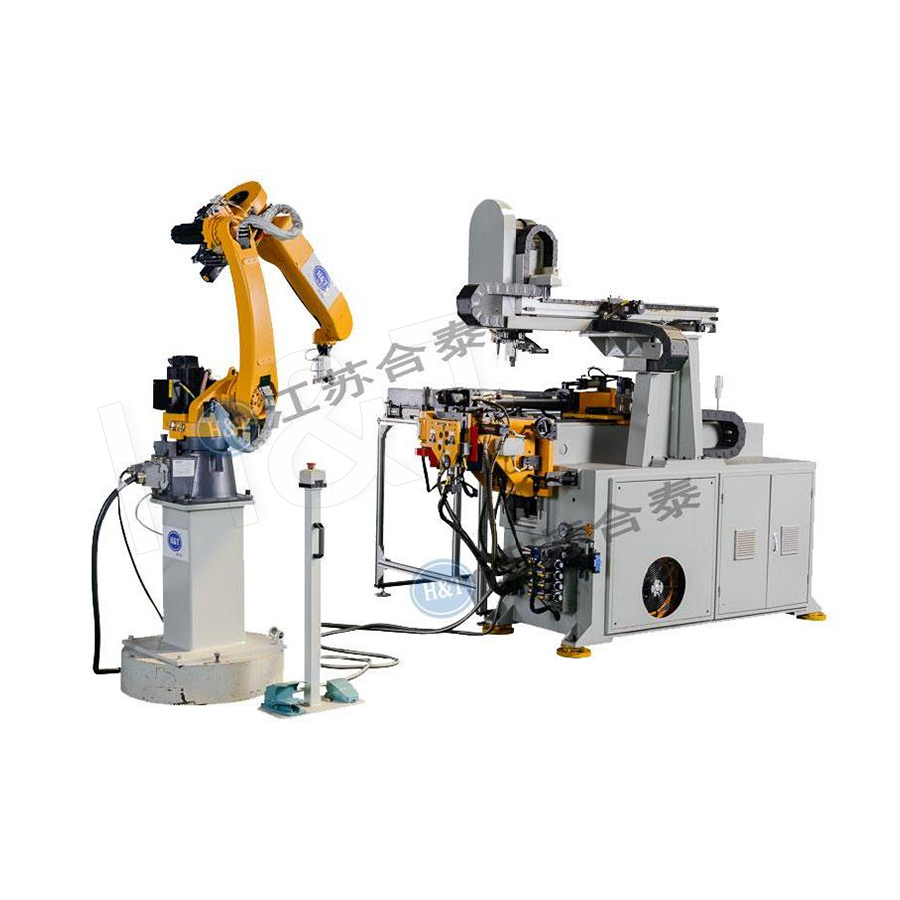
Robot tube bending refers to the deep integration of one or more industrial robots with CNC tube bending machines to form a fully automated system capable of executing the complete tube bending production cycle—feeding, gripping, positioning, clamping, bending, re-gripping for repositioning, and unloading—with minimal or zero operator intervention. The robot handles all material movement and positioning functions while the bending machine executes the programmed bending sequence under CNC control.
This integration transforms a conventional semi-automatic bending cell (where an operator manually loads, positions, and removes each tube) into a lights-out or near-lights-out production system. Robot tube bending cells process tubes with varying diameters, wall thicknesses, bend radii, and complex 3D geometries through the robot's flexible 6-axis motion—adjusting grip position, orientation, and clamping force for each tube specification automatically, without requiring mechanical retooling of the loading/unloading system.
How a Robot Tube Bending Cell Works
A robot tube bending cell integrates multiple systems that communicate through a central cell controller, coordinating all operations in a synchronized production cycle:
- Tube magazine and presentation: Straight tubes are stored in a magazine or bundle loader. A tube separation mechanism (vibratory, roller, or servo-driven) presents one tube at a time to the robot's pick-up position, with orientation aligned to the robot's approach direction.
- Robot pick-up and initial positioning: The robot's end-of-arm tooling (EOAT)—a custom gripper designed for the tube diameter range—picks the tube from the magazine and carries it to the bending machine's chuck or clamp. The robot positions the tube with the programmed insertion depth and angular orientation for the first bend.
- Bending machine clamping and first bend: The bending machine's clamp die closes on the tube. The robot may release its grip (if the bending machine has an integrated carriage) or maintain a coordinated hold. The CNC bending machine executes the first bend with precise servo-controlled angle, speed, and mandrel position.
- Re-gripping for subsequent bends: After the first bend, the robot re-grips the tube at the correct position for the next bend's feed length and rotation angle. This re-gripping sequence—which is the most complex coordination challenge in robot tube bending—is pre-programmed with collision-checked paths for every bend transition in every part program.
- Completion and unloading: After the final bend, the robot carries the finished tube to an inspection gauge, a conveyor, a stacking fixture, or a downstream processing station (end forming, marking, or assembly). The cell controller immediately initiates the next cycle as the robot returns to the magazine.
Key Advantages of Robot Tube Bending
Dramatic Throughput Increase
A robot tube bending cell operates continuously across 24 hours per day, 7 days per week with only brief stops for magazine refilling and periodic maintenance. Compared to a manually tended bending machine operating one 8-hour shift, a robot cell can achieve 2.5–3× more parts per calendar week from the same bending machine—a productivity gain that typically justifies robot integration within 12–24 months on medium-volume automotive production.
Consistent Part Quality and Traceability
Manual loading introduces tube-to-tube variation in insertion depth and angular orientation that contributes to dimensional scatter in the finished part. Robot loading eliminates this source of variation, achieving insertion repeatability of ±0.2 mm and ±0.05°—improving process capability (Cpk) of critical bend dimensions by typically 0.3–0.5 Cpk points compared to manual operation. Every part's production data (robot path used, bending parameters, cycle time) is automatically logged against the part serial number for full traceability.
Flexible Multi-Product Production
The robot's 6-axis motion and programmable EOAT allow it to handle tubes of different diameters, lengths, and wall thicknesses without mechanical retooling of the loading system. Switching between part programs requires only a software recipe selection—the robot, bending machine, and cell controller all load the correct parameters simultaneously. With quick-change EOAT systems (automated tool changers on the robot wrist), diameter changes complete in under 2 minutes.
Multi-Mold Parallel Processing
A single robot can serve multiple bending machines simultaneously—a cell architecture where the robot loads Machine 1 while Machine 2 is bending, then transfers to Machine 2 while Machine 1 bends. This machine-sharing approach can increase overall cell output by 30–50% over single-machine robot cells, and reduces robot idle time (the period when the robot waits for the machine to complete its bending cycle) to near zero.
Robot Tube Bending vs. Manual and CNC-Automated Bending
| Factor | Robot Tube Bending | CNC Auto-Feed Bender | Manual CNC Bender |
|---|---|---|---|
| Operating hours/day | Up to 24 hrs | Up to 24 hrs | 8–16 hrs (shifts) |
| Product mix flexibility | High (6-axis robot) | Medium (fixed feed axis) | High (operator adapts) |
| Part-to-part dimensional consistency | Highest | High | Moderate |
| Multi-machine serving | Yes (1 robot: 2–3 machines) | No | Yes (1 operator: 2 machines) |
| Investment cost | Highest | Medium | Lowest |
| ROI payback (typical) | 12–24 months | 6–18 months | Immediate |
End-of-Arm Tooling (EOAT) Design for Tube Bending
The robot's end-of-arm tooling is one of the most critical engineering decisions in a robot tube bending cell. EOAT must securely grip the tube at multiple positions throughout the bending cycle, accommodate all tube diameters in the product mix, and withstand the forces generated during bending without allowing tube slippage:
- V-block gripper with parallel jaw: The most common design for round tube handling. Two V-blocks (matched to the tube OD) close on the tube from opposite sides. Grip force is servo-regulated to prevent surface marking on polished or coated tubes while maintaining secure hold during transfer.
- Rotating wrist EOAT: For tubes requiring rotation (B-axis repositioning) between bends, a rotating wrist module on the EOAT allows the robot to rotate the tube about its longitudinal axis independently of the robot's wrist axes—increasing programming flexibility and reducing path complexity for complex 3D parts.
- Quick-change EOAT system: An automated tool changer mounts on the robot wrist, allowing it to select from 2–5 pre-staged grippers of different sizes within the cell. This system enables the robot to handle tubes from Ø10 mm to Ø76 mm in a single cell without manual EOAT changes between part numbers.
- Force/torque sensing: A 6-axis force-torque sensor between the robot wrist and EOAT detects unexpected contact forces during tube insertion, preventing tooling damage and triggering safe-stop if the tube is not correctly presented or if a position deviation occurs.
Industry Applications of Robot Tube Bending
Automotive Tier-1 Production Lines
Robot tube bending cells are standard equipment at automotive Tier-1 suppliers producing brake lines, fuel rails, exhaust systems, and air conditioning refrigerant lines. A typical cell produces 800–1,500 tube assemblies per shift of complex 3D tube geometry, with automatic in-process inspection integrated into the robot's unloading path to achieve 100% dimensional check of every part before it enters the shipping buffer.
Aerospace and Defense Components
Aircraft hydraulic lines, fuel system tubes, and pneumatic system components are produced in robot bending cells where the combination of consistent positioning, full digital parameter logging, and integration with CMM inspection creates the AS9100-compliant quality record required for flight-critical components. The robot's ability to handle fragile titanium tubes with controlled, vibration-free motion is particularly valuable in aerospace applications.
HVAC and Refrigeration Systems
Copper refrigerant lines for air conditioning systems, hairpin tube forms for evaporator and condenser coils, and manifold assemblies are produced on robot tube bending cells integrated with end-forming and leak-testing stations. The robot enables continuous multi-product production across refrigerant line sizes from Ø6 mm to Ø28 mm on a single cell, supporting the wide product variety of HVAC equipment OEMs.
Common Questions About Robot Tube Bending
What production volume justifies robot tube bending investment?
Robot cell investment is typically justified at annual production volumes of 100,000 or more tube assemblies per year per part family, or when the combination of volume, part complexity, and quality requirements creates a cost-per-part advantage over manual bending. Automotive brake line families (multiple variants sharing the same robot cell and bending machine) often aggregate to 300,000–800,000 assemblies per year per cell, providing strong ROI within 12–18 months.
How is the robot's re-gripping motion programmed for complex 3D tubes?
Re-gripping paths are programmed offline using simulation software that models the robot, the bending machine, the tube in its current bent state, and all tooling. The software generates collision-free robot paths for each re-grip transition and simulates the full bending cycle at production speed to verify no interference occurs. Final path validation is performed on the physical cell with a slow-speed trial run before production release. Each part program stores its complete robot path, bending parameters, and simulation record as a linked digital package.
What happens when the robot cell encounters a tube defect or jam?
Modern robot bending cells incorporate multiple fault-detection layers: force-torque sensing on the robot wrist detects unexpected resistance during tube insertion; vision systems on the magazine verify correct tube separation and orientation before pick-up; and the bending machine monitors servo current for anomalous bending force (indicating a tube defect or mandrel jam). On fault detection, the cell performs a safe-stop, logs the fault event with timestamp and sensor data, and sends an alert to the operator for intervention. Clear fault recovery procedures programmed into the cell controller minimize restart time to typically 2–5 minutes for common fault types.