

 简体中文
 English
 日本語
 한국어
 Español
 русский
No. 196, Lifa Avenue, Haian City, Nantong, Jiangsu Province, China

News Category
Product Category
CNC Pipe Bending Explained: How It Works, Key Tolerances, and Machine Selection
A roll cage workshop in the middle of a production week is a good place to see why manual pipe bending fails at scale. The same 90 degree bend comes off a lever bender at 87 degrees in the morning and 91 degrees after lunch, and every variation lands on the welding jig as a gap or a strain. The conclusion is straightforward: replace operator judgement with digital control. CNC pipe bending does that by driving every axis from a stored program, and it has become the standard method for tube forming in vehicles, furniture, energy equipment and building structures.
Content
What Is CNC Pipe Bending?
CNC pipe bending is a forming process in which a tube is clamped against a rotating bend die, while servo motors positioned by a computer program control the bend angle, the distance between bends and the plane of each bend. In plain terms, the machine turns a 3D part geometry into physical bends with almost no input from the operator.
The core technology is rotary draw bending with numerical control. A bend arm rotates around a fixed center, pulls the tube around the die, and a control unit coordinates the clamp, the pressure die and the mandrel. Because every movement is recorded as program data, the first part and the thousandth part come off with the same angle when the material and tooling stay the same.
Three specifications define the capability of any CNC pipe bender: the number of controlled axes, the maximum outside diameter it can form, and the range of centerline bend radii it can reproduce. Most production machines run three axes covering bend arm rotation, tube feed and bending plane rotation. Four-axis and five-axis versions add synchronized mandrel and pressure die movement, which is what protects thin-walled tube from collapsing.
The practical benefit is repeatability you can measure. Angle tolerance on a CNC machine is commonly plus or minus 0.1 degrees, while the same bend done by hand varies by 2 degrees or more. On a part with ten bends, the difference between a straight frame and a twisted one is exactly that level of control. For a wider discussion of where programmable bending sits among other forming methods, see our article on what CNC bending is.
How a CNC Pipe Bender Works
The sequence on the shop floor is always the same. The tube feeds forward to a stop, the clamp die locks it against the bend die, the pressure die supports the outer side, and the bend arm rotates until the programmed angle is reached. The clamp then opens, the tube advances to the next position, the plane rotates if the part bends in more than one direction, and the cycle starts again.
Material behavior is the real subject here, not mechanics. When the bend arm releases, the tube springs back toward its original shape, so the machine must over-rotate by a compensation angle. Springback depends on material grade, bend radius and wall thickness. The outer wall also stretches and becomes thinner, while the inner wall compresses; a radius that is too tight produces wrinkles inside and cracks outside.
Springback Allowance by Tube Material
Springback is not a defect; it is the elastic recovery that every metal tube shows after the bending die unloads. The amount is controlled by material strength, bend radius and the wall thickness to diameter ratio. Low-carbon steel returns only 1.5 degrees for a typical 90 degree bend, so the error can pass unnoticed on short parts. Austenitic stainless steels come back 4 to 5 degrees because they work harden faster, which becomes a serious problem on frames with many corners. A CNC machine stores a separate compensation value for each material and radius combination, and the control simply stops the bend arm at a higher angle. Without that compensation, every corner of a long part carries the same error and the assembly fit fails.
Tolerances That Matter on a CNC Pipe Bender
Buying a bender without knowing the tolerance class is like buying a lathe without asking about spindle accuracy. The table below shows the values that separate a true production CNC machine from a light-duty unit.
| Parameter | Typical CNC result | Meaning |
|---|---|---|
| Angle accuracy | +/- 0.1 degrees | Consistent corners across the whole batch |
| Distance between bends | +/- 0.1 mm | Straightforward assembly with mating parts |
| Bend plane alignment | +/- 0.2 degrees | No twisted flanges on 3D parts |
| Wall thinning at 2.5D bend radius | 8 to 12 percent | Safe for hydraulic and structural duty |
| Ovality or flattening | 5 percent or less | Acceptable for tube nuts and O-ring seals |
The most useful rule in daily work is the ratio between the centerline bend radius and the tube outside diameter, written as R/D. At 3D and above, most materials bend without a mandrel and wall thinning stays under 10 percent. At 2D the thinning increases and a mandrel becomes necessary, and below 1.5D only a stiff machine with full tooling can produce a clean bend.
Effect of Bend Radius on Wall Thinning
Wall thinning is a design limit because it changes the pressure rating and fatigue life of the tube. At a bend radius equal to one tube diameter, thinning can reach 40 percent and the outer wall becomes vulnerable. As the ratio increases to 2.5 times the diameter, thinning drops to around 10 percent, which most structural and hydraulic specifications accept. This is why drawings usually state a minimum centerline radius: below 1.5 times the diameter, only a mandrel-supported CNC machine should be used. For a buyer, the practical rule is that a wider allowed radius lowers thinning, reduces wrinkles and keeps the machine cost lower.
Wall thickness and diameter also decide machine class. A light machine bending 20 mm tube can pass with a compact frame, but a 60 mm tube with a 5 mm wall needs a heavier clamp, a longer die stack and a more rigid arm.
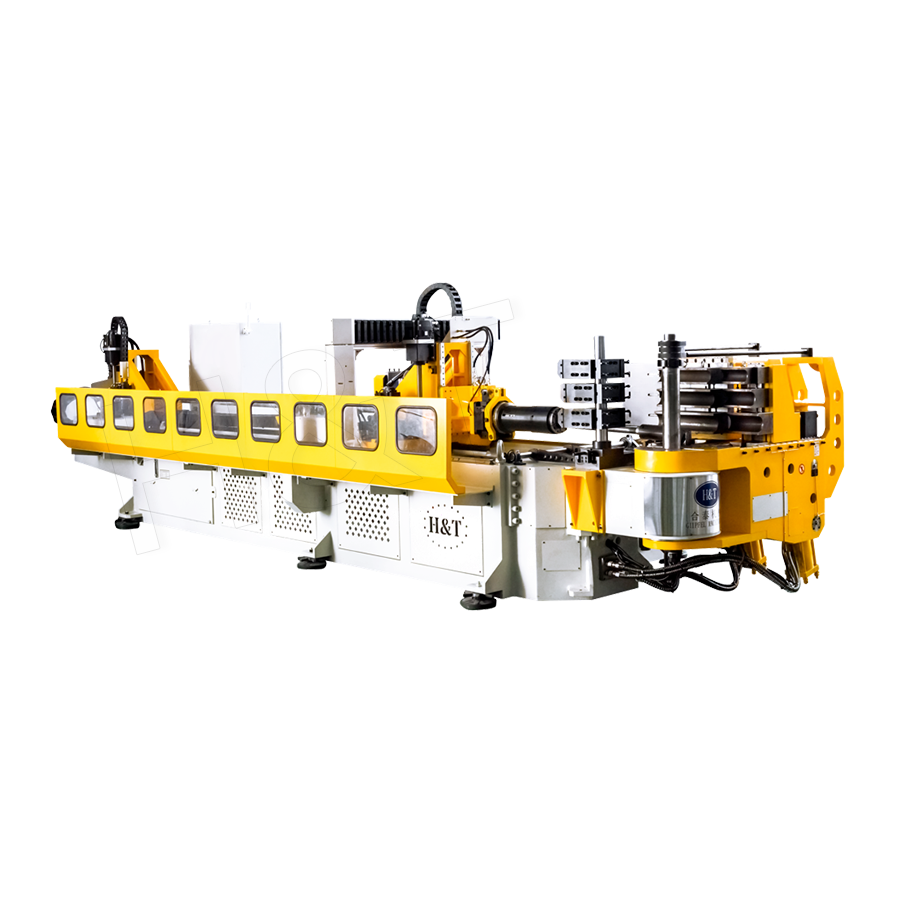 Heavy Duty CNC Tube Bending Machine for Large PipesThis fully servo-driven three-axis bender handles thick-walled and large-diameter pipes with modular molds, automatic compensation, and 3D preview, making it a strong fit for heavy structural bending needs.View Product →
Heavy-duty benders are the standard choice for truck frames, bus handrails and structural steel where the tube diameter and wall thickness are large relative to the bend radius.
CNC, NC or Manual: Where Each Type Fits
The decision between CNC and NC is about the shape of the part range, not about brand preference. NC machines run fixed sequences and are excellent for repeated single-plane bends at medium volume. CNC machines add program-controlled feed length, plane rotation and pressure die positioning, which makes them necessary for multi-bend 3D parts with changing radii.
| Factor | Manual or hydraulic | NC bender | CNC bender |
|---|---|---|---|
| Angle repeatability | +/- 2 degrees or more | +/- 0.5 degrees | +/- 0.1 degrees |
| Multi-bend 3D parts | Not practical | Limited sequence | Fully programmable |
| Setup time per part | 15 to 30 minutes | 10 to 20 minutes | 5 to 10 minutes |
| Operator skill required | High | Medium | Low after programming |
| Typical payback period | Not applicable | Fast on simple parts | Fast on high volume |
Machine Capability Comparison: CNC vs NC
The radar diagram compares a CNC bender with an NC bender across the six factors that matter most in a machine purchase. Accuracy and repeatability show the clearest gap because the CNC machine holds angle tolerance near 0.1 degrees while an NC machine settles at 0.5 degrees. Multi-axis capability and automation push the curves further apart, since an NC control cannot freely combine feed, plane rotation and pressure die movement between consecutive bends. Ease of operation is the closest dimension, as modern NC machines use touch panels inherited from CNC controls. Payback speed is the only angle where NC wins on paper, and that holds only when the part list is short, the radius rarely changes and labor cost is low.
If a production plan involves more than a handful of part numbers, CNC wins quickly because setup data can be recalled in seconds, whereas an NC machine needs mechanical adjustment of stops and dies.
Productivity per Shift: the Difference You Can Budget
Output per hour is the fastest way to estimate payback. Bends per hour depend on the number of axes, the speed of the loading system and the cycle logic, but the spread between machine classes is much larger than most buyers expect.
Typical Productivity by Machine Type
The productivity gap between machine classes is larger than most first-time buyers expect. A skilled operator on a manual machine produces roughly 50 bends per hour because every part is measured and aligned by hand. An NC machine doubles that figure with semi-automatic cycles, but the sequence still runs in a fixed order. A standard CNC bender reaches 400 to 480 bends per hour, while a full-servo machine can exceed 600 bends per hour on simple parts. For a part with eight bends, this means six parts per hour on a manual machine against 75 parts per hour on a CNC machine, which decides whether a contract is profitable.
A full-servo single-head machine with automatic feeding is the typical workhorse for high-mix production because it can switch between part numbers without changing mechanical stops. This is the class of machine most job shops install when contracts grow beyond a few dozen identical parts.
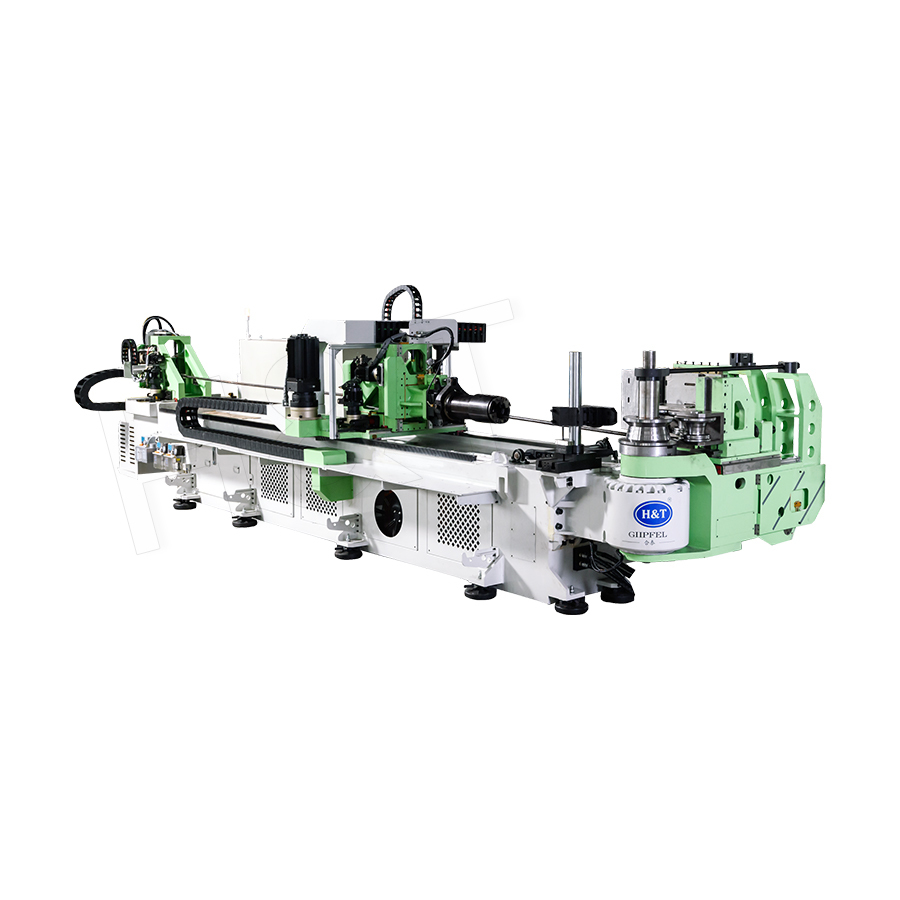 Single Direction Full-Servo Electric Pipe Bending MachineAn all-electric single-head bender covering pipe sizes up to 139 mm, offering high positioning accuracy, low noise, and low maintenance — a practical choice for high-mix job shops.View Product →
Cycle time is only one side of the budget. Tooling cost, setup time and operator training usually matter more on short runs, which is why CNC machines that remember the whole tooling profile pay off once the part library grows.
What to Check Before You Select a CNC Pipe Bender
Start the specification with the part envelope: outside diameter range, wall thickness, required bend radii, and the number of bends per part. Then check the axis configuration against your geometry. A single-head machine with left and right common-side bending covers most tube and pipe work, while double-head machines handle parts that need bends at both ends in one clamping cycle.
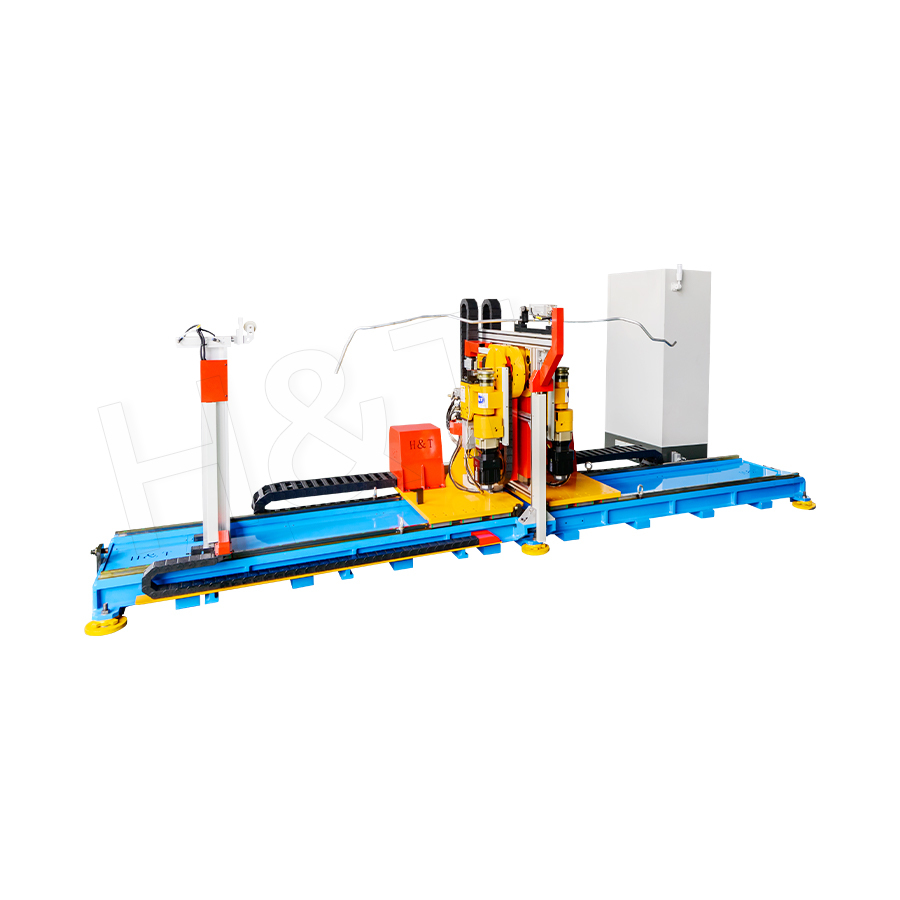 3D Double-Head Full-Servo Pipe Bending MachineThis all-electric double-head bender bends both ends in one cycle, supports up to 180 mm pipe diameter and 300 bend points, and suits complex parts in automotive and HVAC industries.View Product →
Three more checks separate a solid supplier from a brochure. First, ask about control software and whether the machine can store and recall multi-bend programs. Second, look at the automation interface: a machine that can accept a loader, a marking unit or a cutting station will grow into a production cell later. Third, check testing and delivery policy: a reputable builder runs FAT with your tooling and usually quotes 90 to 120 days for a production machine.
Quality signals that matter on paper are design patents, in-house software development and reference installations in your industry. Ask for the number of installations and for customer references that bend the same diameter you bend. A short conversation with an applications engineer is faster than comparing datasheets by yourself, tell us your tube diameter, wall thickness and sample drawing, and you will get a more realistic proposal than any generic catalog.
Make the Switch Sooner Rather Than Later
CNC pipe bending is not a luxury once the batch size passes a few dozen parts. The same eight-bend part that needs ten minutes on a manual machine runs in under a minute on a CNC machine, with repeatability that protects your welding jig and your delivery promises. Define your tolerance class, count the axes, and match the frame capacity to the hardest part in your range. That is the whole logic of choosing a CNC pipe bender.
Featured Products
A Complete Range of Tube Processing Solutions
Precision Tube Bending
 Ready To Customise
Your Bent Tube Products?

Ready To Customise Your Bent Tube Products?
Proprietary software, smart control systems, and 50+ patents ensure more efficient and intelligent production at every step.
Copyright © 2025 by Gipfel Precision Machinery Co.,Ltd All Rights Reserved. Privacy Precision Tube Machinery Manufacturer | Pipe Forming, Cutting, End Forming Solutions
