

 简体中文
 English
 日本語
 한국어
 Español
 русский
No. 196, Lifa Avenue, Haian City, Nantong, Jiangsu Province, China

News Category
Product Category
What Is a CNC Steel Pipe Bending Machine? Complete Guide for Factories
A fabrication shop wins a contract for 800 identical steel pipes with four bends each. The operator can bend them manually, but after the first fifty parts the angle drifts, the clamp marks appear, and the quality inspector rejects more and more pieces. That is the moment when the discussion turns to a CNC steel pipe bending machine.
A CNC steel pipe bending machine is an automated tool that bends steel pipes using pre-programmed instructions instead of hand-operated levers. It repeats the same bend geometry throughout the batch, which is what production managers need when tolerances are tight and delivery dates are fixed. This article explains what the machine is, how its main components work, how it compares with NC and manual bending, the common machine types, and what to evaluate before you buy.
Content
- 1 What Is a CNC Steel Pipe Bending Machine?
- 2 Why CNC Precision Matters in Real Production
- 3 Key Components You Should Know
- 4 How Do CNC, NC, and Manual Bending Compare?
- 5 Common Types of CNC Steel Pipe Bending Machines
- 6 What Production Benefits Can You Expect?
- 7 How to Choose the Right CNC Steel Pipe Bending Machine
- 8 Final Advice
What Is a CNC Steel Pipe Bending Machine?
A CNC steel pipe bending machine controls the bending process with a computer program. The program tells the machine three things: how far to feed the pipe forward, how much to rotate the pipe plane between bends, and which bend angle to reach on the bending arm. These three movements are usually called the feed axis, the plane rotation axis, and the bending axis. When they work together, the machine can form a complex 3D pipe shape without moving the pipe to another workstation.
Three basic movements define the machine capability:
- X axis: the distance the pipe feeds forward between bends.
- Y axis: the rotation of the pipe around its own axis before the next bend.
- C axis: the angle of the bend formed by the bending arm.
CNC bending means the operator loads a program and the machine performs the sequence automatically. Every pipe in the batch follows the same path, so the first part and the last part are identical. If you want a plain-language introduction to the control principle, you can read this overview of CNC bending.
Why CNC Precision Matters in Real Production
The first reason to invest in a CNC steel pipe bending machine is consistency. Manual bending depends on the operator's eye, so the angle can drift by one or two degrees across a long shift. In a pipe assembly with several bends, that small drift accumulates and turns into gaps, leaks, or forced assembly. The chart below shows where each bending method stands on positioning tolerance.
Typical position tolerance of bending methods
Manual bending normally holds a position tolerance of about 2 mm, which is enough for simple supports but risky for hydraulic lines. NC bending improves the result to roughly 0.6 mm because the machine stops at a preset angle, yet the plane rotation is still set by hand. A full-servo CNC machine holds about 0.1 mm and repeats that value day after day without operator adjustment. The practical impact is that final assembly fits without rework, and thin-walled steel pipes bend without collapsing or wrinkling. Over a production year, the saved rework time and material usually justify the higher purchase price.
Key Components You Should Know
You do not need a maintenance degree to compare machines, but knowing the tooling names helps you talk to the builder and budget for spare parts. The core parts of a rotary draw CNC bender are listed below.
- Bend die: defines the inner radius of every bend.
- Clamp die: holds the pipe against the bend die so the pipe cannot slip.
- Pressure die: pushes the straight section forward while the bend is formed.
- Wiper die: prevents wrinkles on the inside radius of the bend.
- Mandrel: supports the inner wall of the pipe and prevents flattening.
- Lubrication system: reduces friction between the tube and the dies.
- Servo drive system: moves each axis with closed-loop position feedback.
- Controller: stores the bending programs and coordinates all axes.
The number of servo axes and the quality of the dies have a direct effect on price and service life. A machine with closed-loop servo drives keeps its accuracy for years, while a machine with open-loop drives or weak tooling can drift after heavy use. When you compare quotes, ask which components are servos and which are plain cylinders.
How Do CNC, NC, and Manual Bending Compare?
The decision is not always CNC versus everything else. If your parts are simple and your volumes are low, an NC machine may be enough. But when the drawing contains bends in multiple planes, tight angle tolerances, or thin walls, CNC becomes the practical choice.
| Control method | Program memory | Typical tolerance | Operator skill | Investment | Best fit |
|---|---|---|---|---|---|
| Manual | None | About 2 mm | High | Low | Prototypes and repair work |
| NC | Angle presets | About 0.6 mm | Medium | Medium | Medium batches with simple planes |
| CNC | Full 3D program | About 0.1 mm | Low | High | Complex parts and high volume |
Capability comparison of manual, NC, and CNC bending
The radar chart compares six capabilities that matter in daily production. CNC bending scores highest in precision, repeatability, complex bend shapes, and automation, but it requires a higher initial investment and some programming skill. NC bending sits in the middle and makes sense as an upgrade when the parts are simple and the batch size is moderate. Manual bending still wins in ease of operation for one-off parts, which is why many workshops keep a manual bender even after installing CNC equipment. The real question is not which method is the best in theory, but which one matches your bend tolerances and batch sizes. For parts with multiple plane changes and tight angles, CNC is the only option that delivers consistent results.
Common Types of CNC Steel Pipe Bending Machines
The most practical way to classify CNC benders is by head configuration and load capacity. Single-head machines are the most flexible for small and medium batches, double-head machines shorten cycle time for double-ended parts, and heavy-duty machines handle pipes that require high bending torque.
Single-Head CNC Steel Pipe Bending Machines
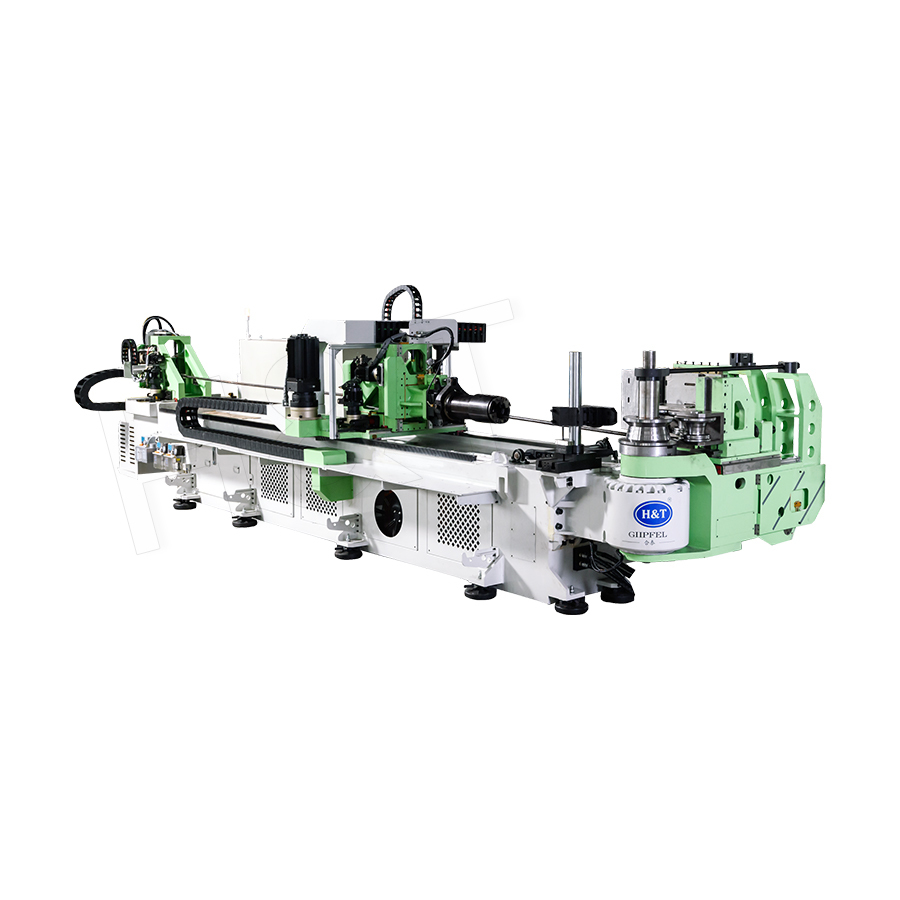 Single-head all-electric CNC pipe bender for small to medium batchesThis single-head full-servo machine offers high-precision bending with electric drive, covering pipe diameters up to 139mm. It suits flexible small and medium batch production and integrates easily with automatic feeding.View Product →
A single-head bender forms one bend at a time and is the most common layout for small and medium batches. The operator loads the pipe, the machine bends, and the same program runs again for the next part. These machines cover a wide range of tube diameters and are easy to integrate with automatic feeding.
Double-Head CNC Steel Pipe Bending Machines
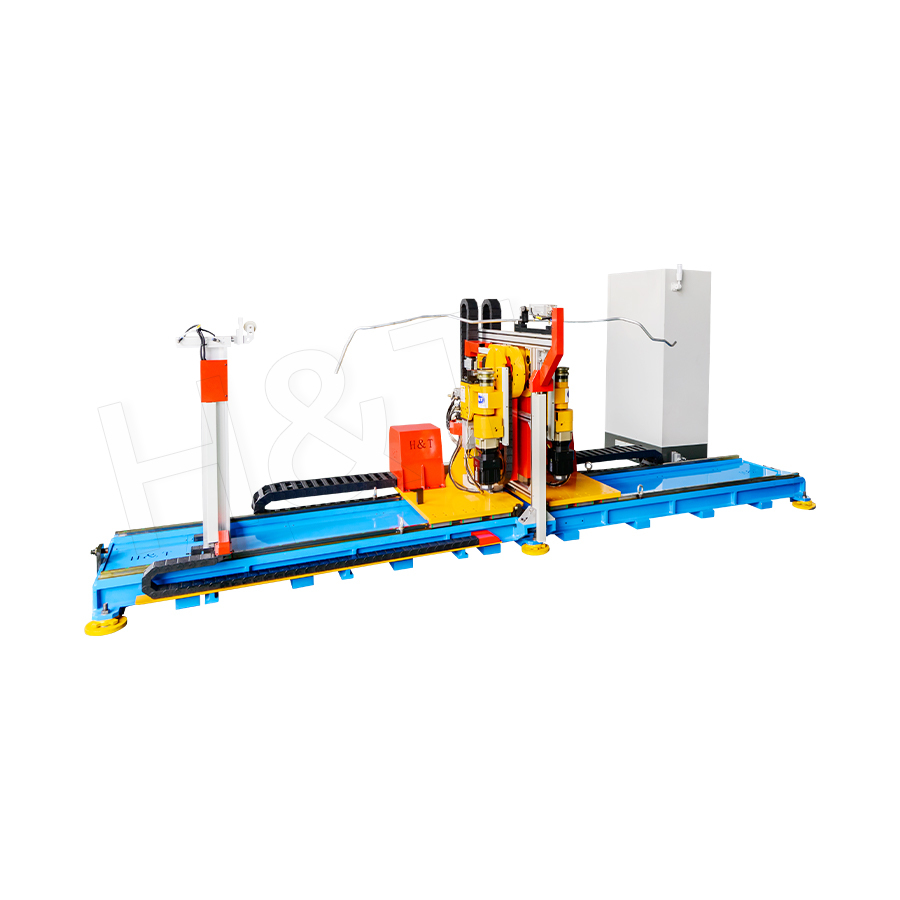 3D double-head all-electric bender for simultaneous two-end bendingThis double-head full-servo machine bends both pipe ends in one pass, boosting cycle speed for parts like automotive and furniture tubes. It supports up to 180mm diameter and 300 bend points per part.View Product →
A double-head bender has a bending arm on both sides of the machine. It is designed for parts that need bends on both ends, such as furniture frames, vehicle seat structures, and exhaust lines. Because the two heads work from opposite sides, the cycle time is much shorter than bending and rotating the part on a single-head machine.
Heavy-Duty CNC Steel Pipe Bending Machines
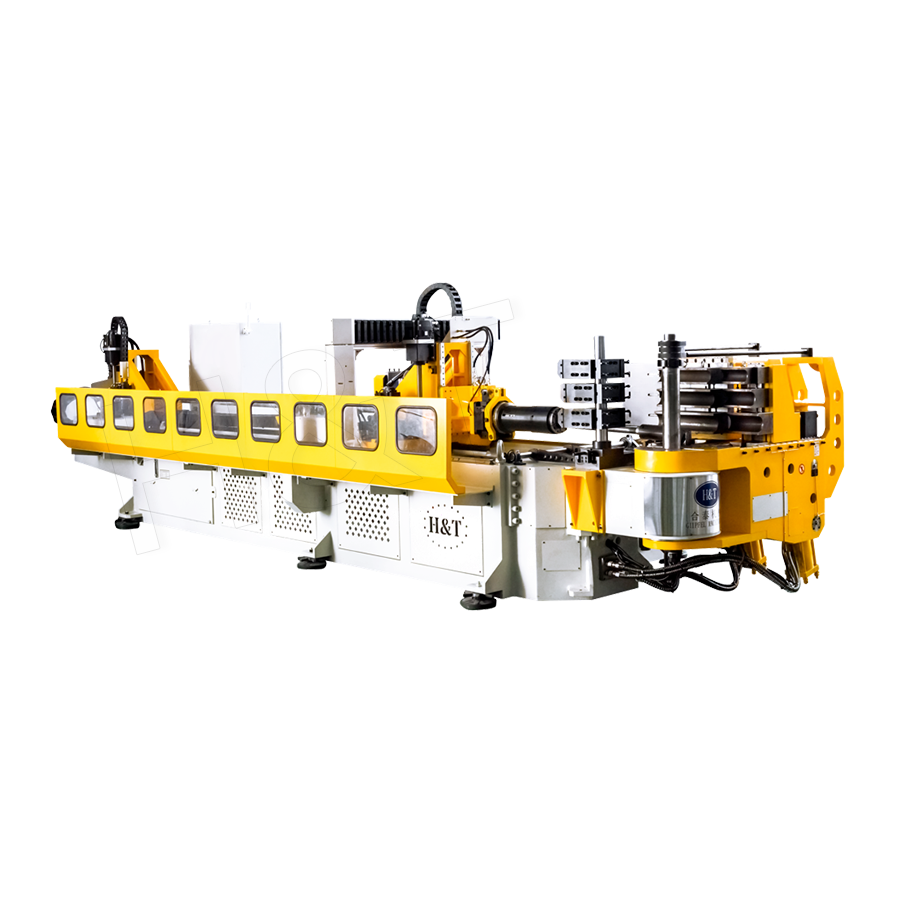 Heavy-duty servo-driven CNC bender for thick-walled and large-span pipesBuilt for demanding industries like aerospace and automotive, this heavy-duty machine handles high-torque bending with multi-layer dies and intelligent compensation, enabling precise forming of long, thick-walled tubes.View Product →
When the pipe diameter and wall thickness demand high torque, a standard bender cannot keep the pipe from twisting during the bend. Heavy-duty CNC benders are built with stronger frames, larger bend dies, and bigger servo motors to hold the pipe rigidly. They are common in truck frames, construction equipment, and structural steel fabrication.
What Production Benefits Can You Expect?
The business case usually comes down to two measurable numbers: cost per bend and material waste. Both improve as batch size grows and the machine runs with less supervision.
Cost per bend versus batch size, illustrative values
The line chart compares the cost per bend for manual and CNC processes at different batch sizes. For a batch of 10 parts, the manual bender looks cheaper because no programming time is spent. At around 50 parts, the two methods are close, because the CNC machine starts to recover its setup cost while the manual operator begins to slow down. After 100 parts, the CNC line falls clearly lower because the machine runs more consistently and rejects fewer pieces. The exact crossing point depends on machine price, part complexity, and labor cost, so every workshop should calculate it with real numbers. In most evaluations, CNC bending pays off well before the 500-part point when a part has more than three bends.
Typical material waste rate by bending method
This column chart shows how the bending method influences material yield. Manual bending typically produces around 8 percent waste when test pieces, misbends, and scrapped pipes are added together. NC bending reduces the waste to about 3 percent, mainly because the angle is applied mechanically, but positioning errors still occur. CNC bending brings the waste down to less than 1 percent in a normal production run. The savings matter twice because the pipe itself is expensive and every reject also consumes cutting, handling, and inspection time. Over a year of operation, the material saving alone can make a significant contribution to the machine payback.
How to Choose the Right CNC Steel Pipe Bending Machine
The fastest way to compare machines is to prepare a part list and a production target before asking for quotes. The machine builder needs the same information you use for costing, and the quality of the answer depends on how clearly you describe the work.
Checklist for your inquiry
- Outer diameter, wall thickness, and steel grade of the pipe.
- Center line radius and angle of every bend on the part.
- Number of bends per part and whether the plane changes between bends.
- Maximum pipe length that must fit through the machine bed.
- Bending direction requirements, such as left and right bends or bends on both ends.
- Current cutting, chamfering, and end forming steps around the bender.
Send the list together with a sample drawing. A good builder will confirm the mandrel length, clamping force, cycle time, and tooling cost before signing the order. Ask how the machine is tested before delivery and whether the service team can help with die selection. You can also send your part drawing to the manufacturer through the contact page and get a bending feasibility check at an early stage.
Final Advice
A CNC steel pipe bending machine is a long-term production asset, not a one-time purchase. The accuracy comes from the servo drives and software, but the daily reliability depends on die quality, the lubrication routine, and the support behind the machine. Many workshops compare only the base price and later find that tooling and service cost more than the machine within two years. Builders that develop their own software and test every machine with real bends, such as Gipfel Precision Machinery Co., Ltd., tend to deliver more predictable results. If you evaluate the payback with your real batch sizes and tolerances, the machine becomes a measurable improvement in quality, delivery time, and production capacity.
Featured Products
A Complete Range of Tube Processing Solutions
Precision Tube Bending
 Ready To Customise
Your Bent Tube Products?

Ready To Customise Your Bent Tube Products?
Proprietary software, smart control systems, and 50+ patents ensure more efficient and intelligent production at every step.
Copyright © 2025 by Gipfel Precision Machinery Co.,Ltd All Rights Reserved. Privacy Precision Tube Machinery Manufacturer | Pipe Forming, Cutting, End Forming Solutions
