

 简体中文
简体中文 English
 日本語
日本語 한국어
한국어 Español
 русский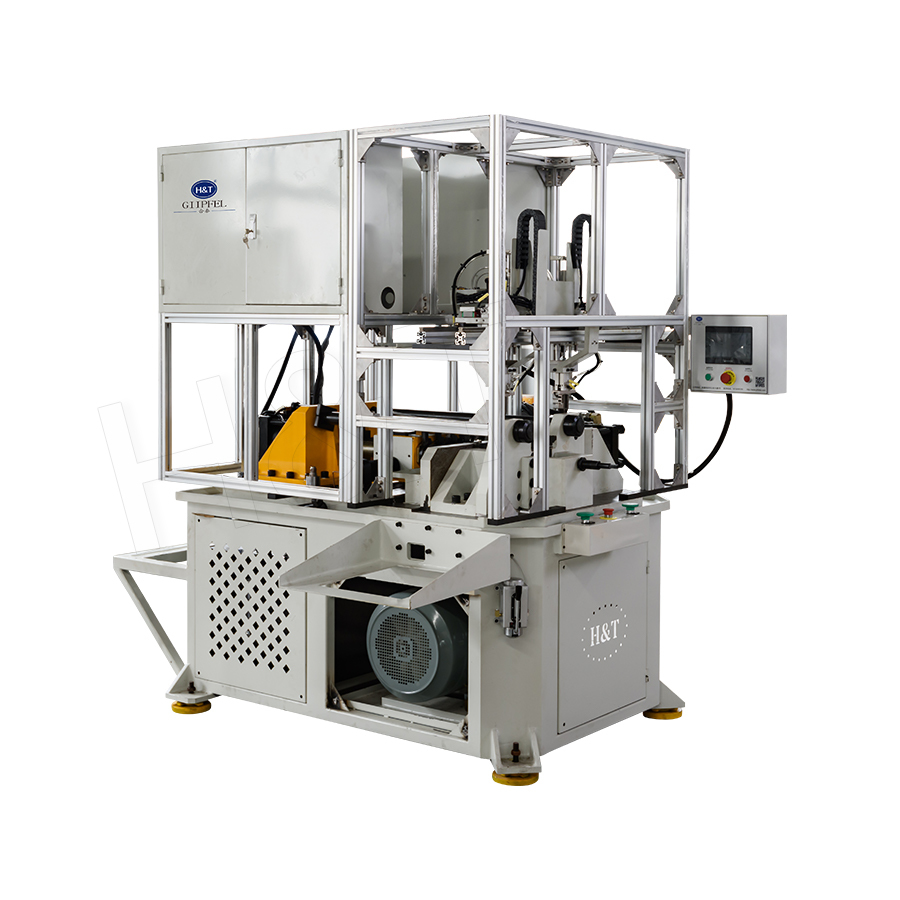
No. 196, Lifa Avenue, Haian City, Nantong, Jiangsu Province, China

News Category
Product Category
CNC Tube Forming: How to Choose Machines for Bending, Cutting, End Forming
An engineering manager called us last month with a familiar problem: his shop had just won a contract for 12,000 bent tubes, but the existing manual bender could not hold the ±0.5 mm tolerance the customer required. He needed a machine that could combine multiple bend radii, avoid flattening the tube wall, and still keep cycle times below 30 seconds. This is exactly the kind of decision where CNC tube forming earns its place.
CNC tube forming is not a single machine. It is a carefully integrated combination of bending, cutting, end forming, and often automation. The practical benefits are higher repeatability, shorter changeover, and lower scrap, but only when you match the machine to the actual part family.
Content
- 1 What Exactly Does CNC Tube Forming Cover?
- 2 Why CNC Tube Forming Beats Manual and NC Bending
- 3 Key Specifications That Affect Tube Bending Quality
- 4 Single-Head, Double-Head, or Robot Bending: How to Choose
- 5 Total Cost of Ownership: Why Initial Price Is Only the Beginning
- 6 End Forming and Cutting Should Not Be Afterthoughts
- 7 How to Evaluate a Manufacturer Before Buying
- 8 Final Recommendation
What Exactly Does CNC Tube Forming Cover?
CNC tube forming refers to the use of computer-controlled equipment to change the shape of tubes and profiles. It normally covers three operations: tube bending, tube end forming, and tube cutting. Bending forms the center axis of the part; end forming flares, reduces, expands, grooves, or finishes the ends; cutting creates the starting blanks and the finished length. In many cells, feeding, unloading, and transfer between operations are automated to create a continuous process.
A full CNC forming line can include a CNC bending machine, a circular metal saw or laser cutting machine, an end former, and a deburring station. See our guide on what is CNC bending to clarify the core technology. Choosing the right combination depends on material, geometry, tolerances, and annual volume.
Why CNC Tube Forming Beats Manual and NC Bending
Manual benders are fine for low-volume prototypes and maintenance work, but they rely on operator skill and cannot compensate for springback consistently. NC machines add programmable motors, but they typically control only one or two axes and are designed for simple, repetitive bends. CNC machines use servo-driven axes, digital angle inputs, and automatic springback compensation, which make them suitable for complex 3D parts.
The practical result is higher throughput and repeatable quality. The horizontal bar chart below shows realistic output envelopes for five equipment families commonly considered during a tube forming line design.
The horizontal bar chart above compares realistic output ranges for five common equipment families. Manual bending usually stays below 20 parts per hour, because the operator must load, position, bend, and measure each tube. A single-head NC machine improves that to roughly 40 parts per hour for standard bends. CNC single-head machines can reach 90 parts per hour on smaller radii, while CNC double-head models can reach about 140 parts per hour by bending both ends in one loop. Robot-assisted cells are flexible but not always the fastest, so they sit between CNC single-head and double-head on throughput.
For production planning, the chart should be treated as a capacity envelope, not a guarantee. Real output depends on wall thickness, bend radius, material, and how much inspection is needed. The key conclusion is that replacing manual bending with CNC forming usually triples or quadruples throughput while reducing operator fatigue.
Key Specifications That Affect Tube Bending Quality
Before purchasing a CNC tube forming machine, you have to understand the minimum bend radius, the wall factor, and the springback pattern. Bending a tube to too small a radius causes collapse, wrinkling, or wall thinning. A general rule is that the centerline radius should be at least 2.5 times the tube outside diameter for carbon steel, and closer to 3 times for stainless. Tighter radii require internal mandrel support, wiper dies, or heavier machines.
Springback is the second critical variable. The line chart below shows a typical springback compensation curve for mild steel bent around a 2D radius. The compensation is not linear, so a machine without a digital angle control system will produce inconsistent parts as the bend angle changes.
The line chart shows how springback compensation grows with the bend angle for a mild steel tube. At 30 degrees, the steel tube springs back only about 1.2 degrees, which a controller can correct easily. At 90 degrees, the compensation is roughly 5 degrees, meaning the machine must over-bend to 95 degrees to achieve 90 after release. At 180 degrees, the compensation can reach 12 degrees or more. This non-linear behavior is why a CNC controller with springback tables and measured feedback is essential. Ignoring springback is the most common cause of out-of-tolerance parts in tube bending.
If you are forming high-strength steel or aluminum, request a test bend under your production parameters. The machine software should allow you to store each bend program, including material, tooling, and compensation values.
Heavy profiles and thick walls can stall a standard machine. That is when a heavy-duty CNC bender with higher torque and a stiffer frame becomes necessary.
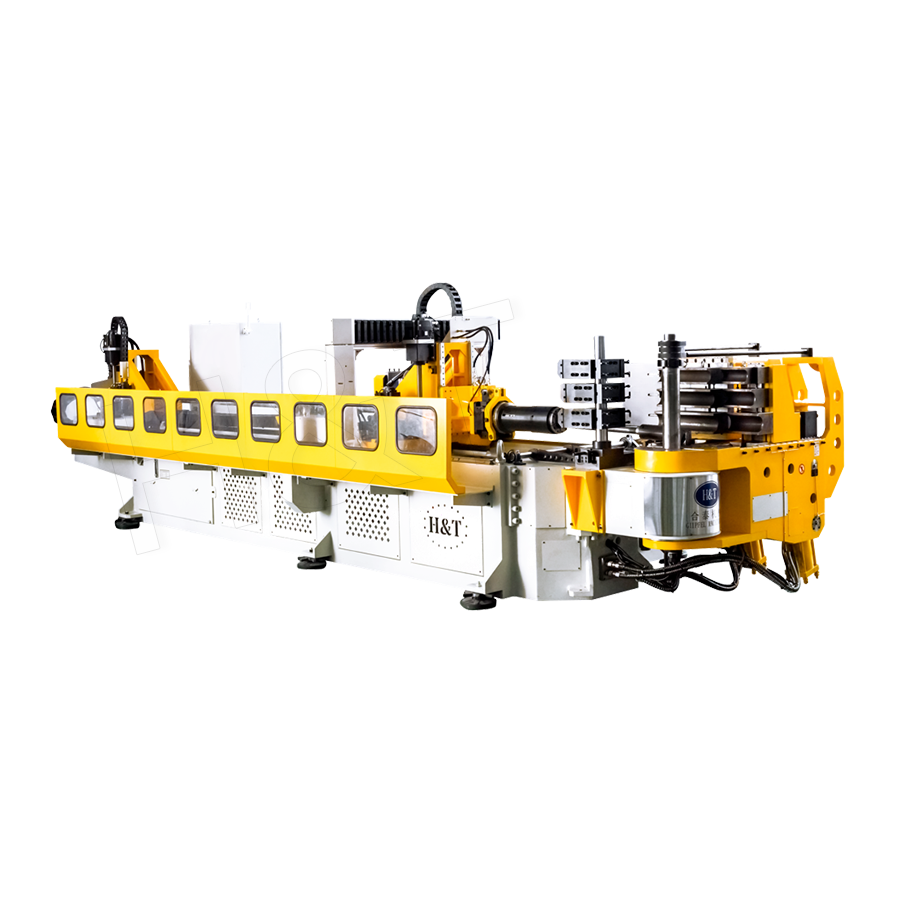 Heavy-Duty CNC Tube Bending Machine for Thick-Walled PipesThis fully servo-driven three-axis bender handles large-span and ultra-thick-walled pipes with high torque and a stiff frame, making it suitable for demanding structural applications where lighter machines would struggle with wall thinning.View Product →
Review the axis count, clamping force, and available tooling options before committing to a model. A machine designed for automotive structural tubes may be overkill for furniture frames, while a light machine will struggle with wall thinning on high-strength steel.
Single-Head, Double-Head, or Robot Bending: How to Choose
The number of bending heads changes both cycle time and flow. A single-head machine bends one tube at a time and is ideal for long tubes, tight radii, or complex 3D shapes. A double-head CNC machine, especially a full servo model, can bend both ends of a tube without moving the tube to a second setup, which reduces time and handling. Robot tube bending adds a robotic arm to load, rotate, and position tubes, making it easier to automate a cell around one bender.
Your choice should be made after mapping current and future part families. When a part family has long tubes with bends at both ends, a double-head machine eliminates re-fixturing and improves cycle time by as much as 30 percent compared with two single-head passes.
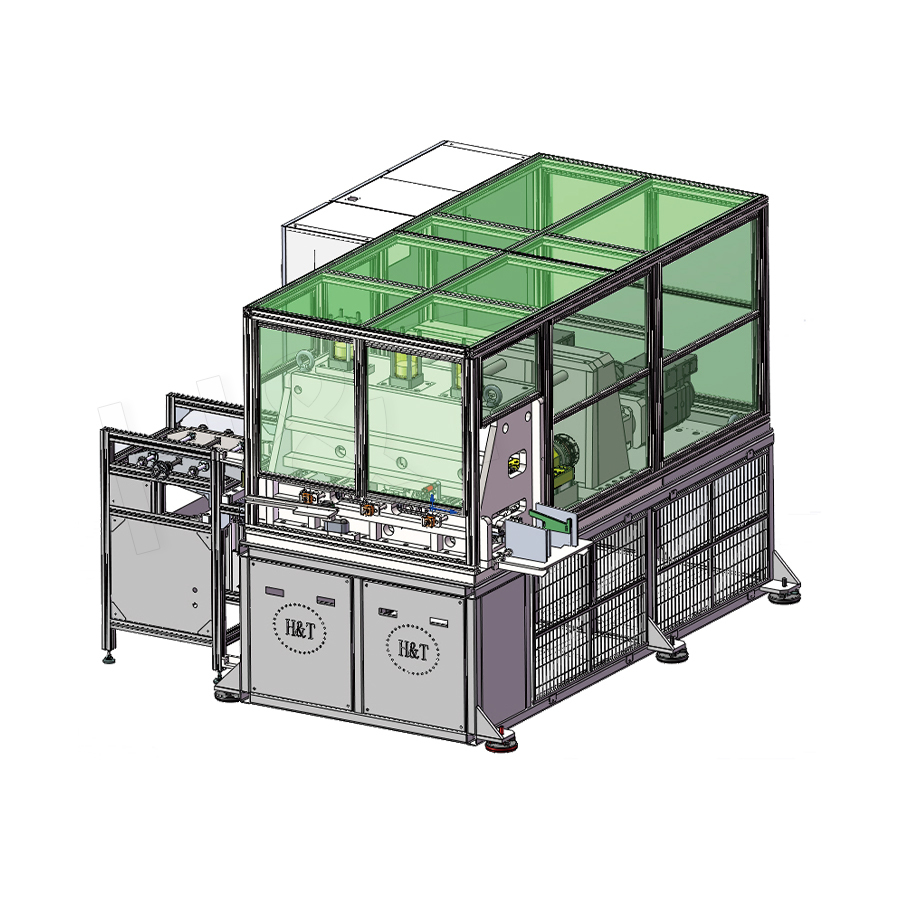
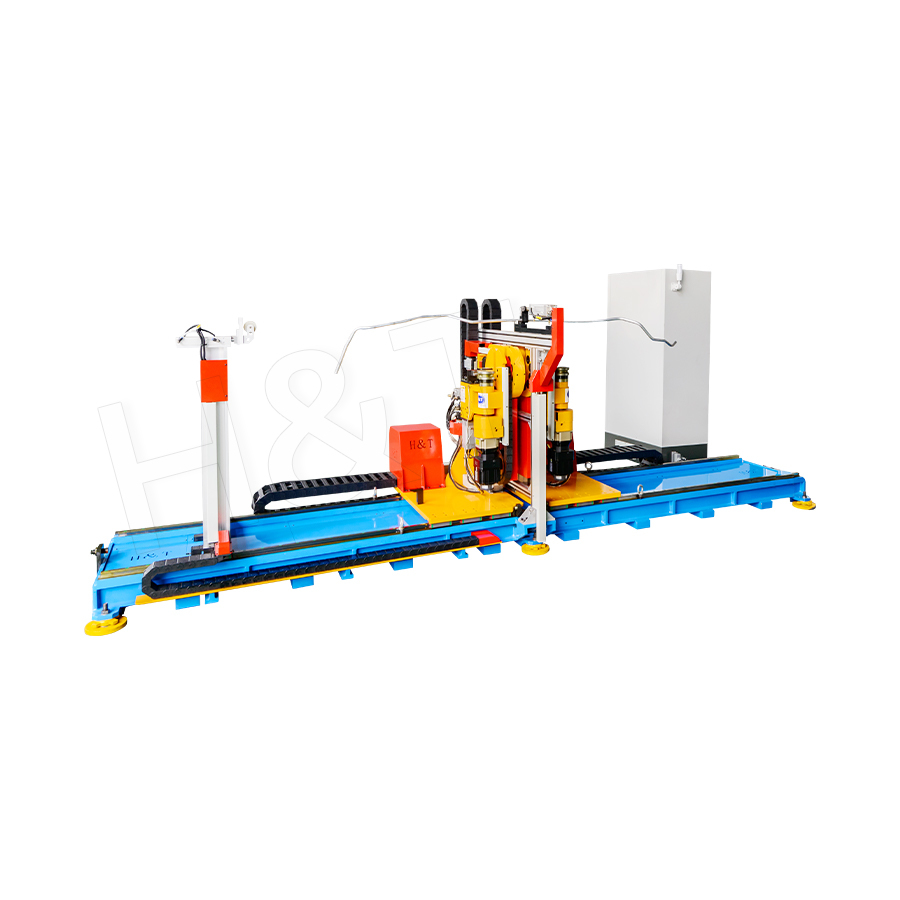 3D Double-Head Full-Servo Bending Machine for Long TubesThis all-electric double-head bender performs simultaneous bends on both ends in one pass, supporting pipes up to 180 mm and complex multi-bend parts, ideal for high-mix production where cycle time and accuracy are critical.View Product →
Robot cells are a different trade-off. They increase flexibility to handle multiple part numbers in one cell, but the initial engineering cost is higher. For high-mix, low-to-medium-volume production, a robot bender is often the right answer; for very high volume, a dedicated CNC double-head bender may be the better economic choice.
The radar chart places three machine types on six practical attributes. The CNC single-head leads in precision and repeatability because its servo axes are matched to the bend head and collet. The robot cell leads in flexibility because the part path is not limited by a single head geometry. The NC machine has the easiest setup and the lowest operator skill requirement, but it falls behind in repeatability. For a typical automotive or furniture frame project, precision and repeatability weigh more than setup ease, which is why CNC systems dominate continuous production.
Total Cost of Ownership: Why Initial Price Is Only the Beginning
Purchase price is the first number buyers compare, but it does not predict operating cost. Labor, tooling, scrap, and downtime usually represent a larger share of the total over five years. The stacked bar chart below is an illustrative cost model for four equipment approaches, using typical labor rates and scrap rates for medium-series production.
The stacked bars show total five-year cost in thousands of dollars for a typical medium-volume part family. Manual equipment has the lowest initial cost, but high labor and scrap costs push the total to 295 thousand dollars. NC equipment lowers labor but still creates measurable scrap, ending at 260 thousand. A CNC machine has a higher initial outlay, yet reduced labor and scrap bring the total to 255 thousand. Robot cells are the most expensive to launch at 275 thousand because of integration and guarding costs. The conclusion is that CNC tube forming becomes more attractive as labor rates rise and quality requirements tighten.
End Forming and Cutting Should Not Be Afterthoughts
CNC tube forming is not only bending. A tube that is shaped before cutting or after bending may require flaring, reducing, expanding, grooving, or chamfering. End forming operations often dictate assembly quality, especially if the tube is inserted into a hydraulic fitting, a flange, or a weld neck. Cutting must be clean and square because a poor cut affects the grip and sealing of the end form. For this reason, many manufacturers combine cutting, chamfering, deburring, and end forming into a single automated line.
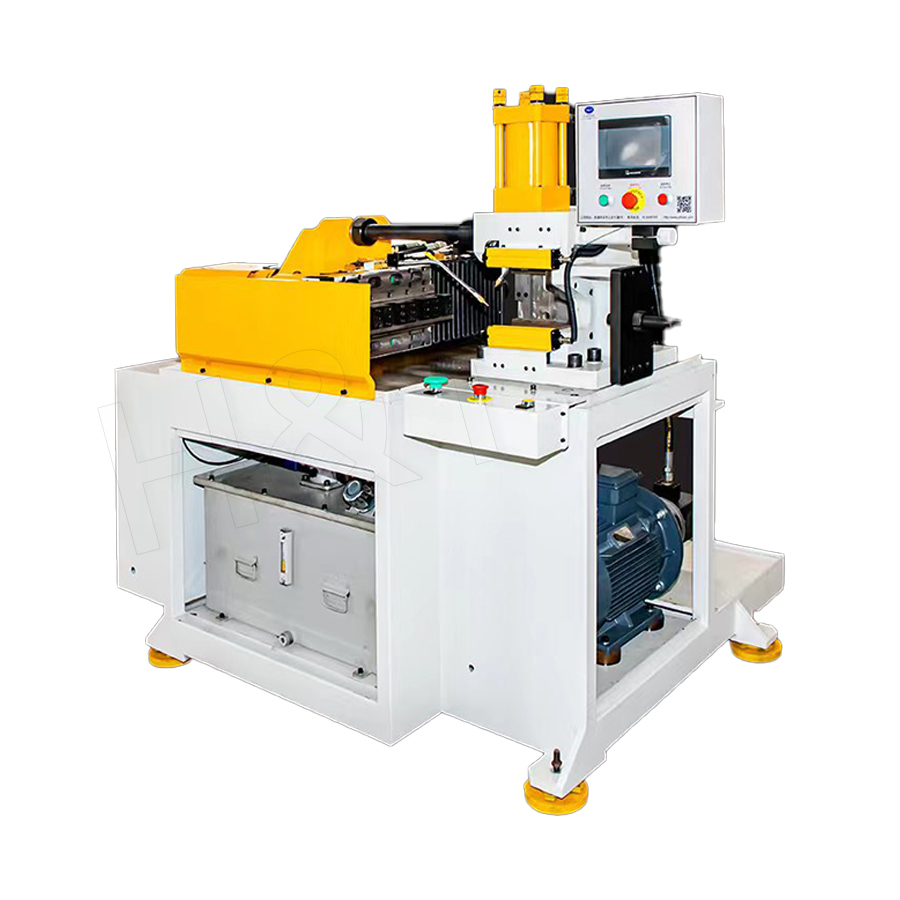
When you plan a new tube forming cell, evaluate the complete sequence from raw tube to finished component. A bending machine with a perfect angle is useless if the tube end cannot accept a fitting. For detailed specifications, a dedicated tube end forming machine is a good starting point.
 Hydraulic Tube End Forming Machine with Custom MoldsThis PLC-controlled end former handles expansion, contraction, and other end shaping tasks with precision linear guides and a cooling system, complementing bending operations by preparing tube ends for fittings and downstream processing.View Product →
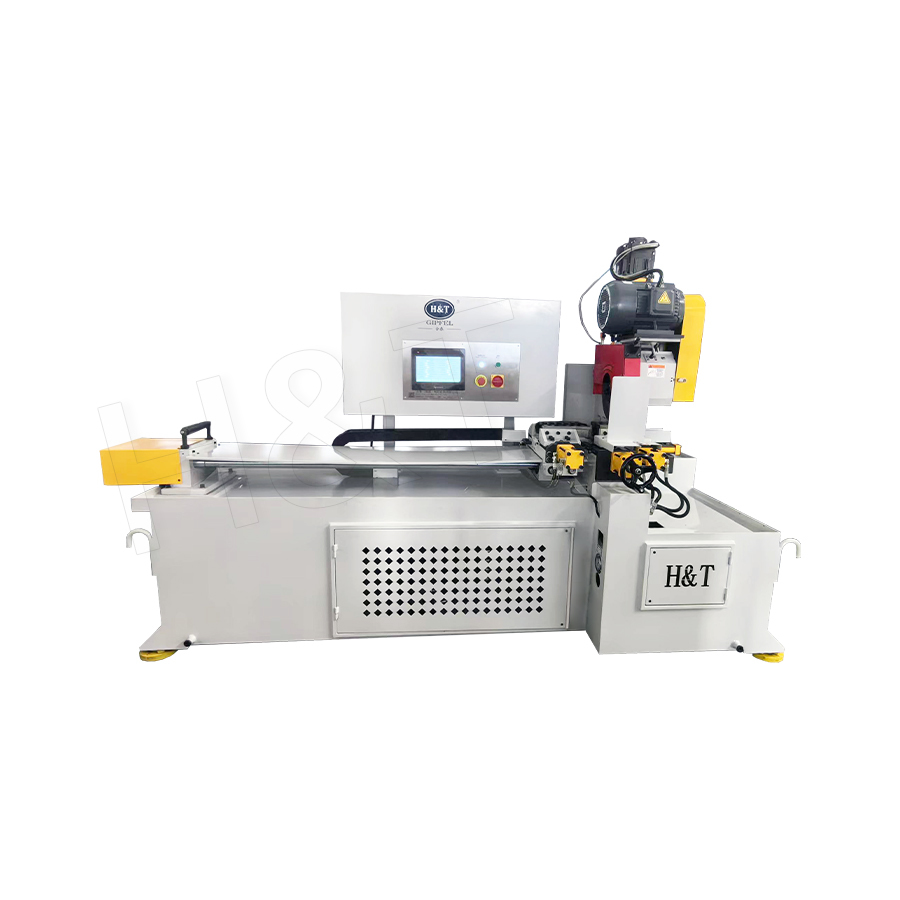
Laser cutting is often paired with CNC bending when the tube has angled cuts, slots, or holes that must align with a bend plane. Circular saws are more economical for straight, chamfered blanks. The best layout depends on cycle time, part weight, and how many operators you need to maintain.
How to Evaluate a Manufacturer Before Buying
The machine builder matters as much as the machine specification. A truly integrated tube forming equipment manufacturer should handle software development, precision machining, welding, assembly, and testing in-house. This internal capacity is what makes a 90 to 120 day delivery period realistic and stable. It also makes troubleshooting faster because the builder knows the machine from the casting up, not just from the catalog.
Ask for FAT and SAT procedures before you place an order. A factory acceptance test validates the machine in the builder's shop, while a site acceptance test proves it works in your facility. If the builder cannot provide clear test criteria for bend angle, springback, and cycle time, the purchase becomes a gamble.
Check the software portfolio as well. A good CNC tube forming line depends on bend programs, tooling libraries, compensation tables, and integration with your ERP. Manufacturers that write their own software can adjust workflows instead of forcing you to adapt to a black box.
Finally, request direct contact with the application engineers. Tell them your material, tube diameter, wall thickness, bend radii, and volume. The best response is a machine recommendation with a specific tooling list and a test plan. You can contact us for a quote and a feasibility review of your parts.
Final Recommendation
CNC tube forming succeeds when you measure three things: repeatability, total cost, and production flow. Start with the part geometry and tolerance, then choose the forming method, then select a builder with proven integration ability. Heavy-duty applications need a stronger frame; long assemblies with both ends bent need a double-head servo machine; high-mix batches may justify a robot cell. End forming and cutting equipment must be part of the same conversation, not an afterthought. If you evaluate the full sequence with real production data, the right CNC tube forming solution is easier to justify and easier to keep running.
Featured Products
A Complete Range of Tube Processing Solutions
Precision Tube Bending
 Ready To Customise
Your Bent Tube Products?

Ready To Customise Your Bent Tube Products?
Proprietary software, smart control systems, and 50+ patents ensure more efficient and intelligent production at every step.
Copyright © 2025 by Gipfel Precision Machinery Co.,Ltd All Rights Reserved. Privacy Precision Tube Machinery Manufacturer | Pipe Forming, Cutting, End Forming Solutions
