

 简体中文
简体中文 English
 日本語
日本語 한국어
한국어 Español
 русский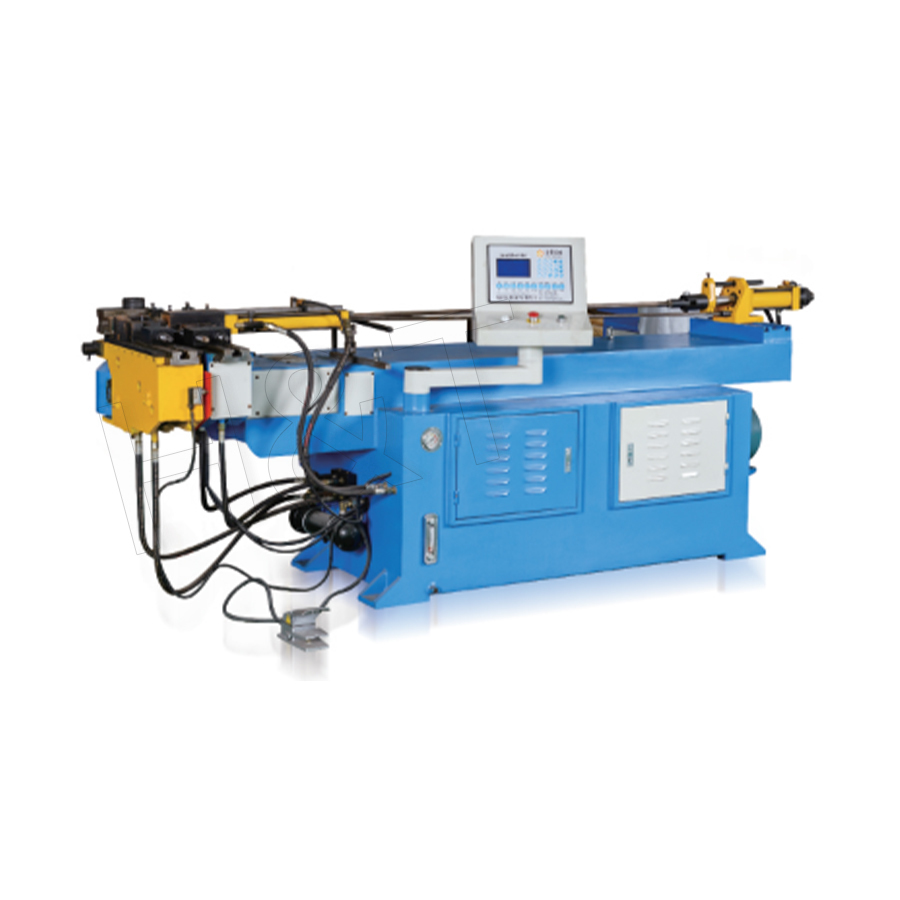
No. 196, Lifa Avenue, Haian City, Nantong, Jiangsu Province, China

News Category
Product Category
What is NC bending?
NC bending refers to Numerical Control pipe bending, a manufacturing process that uses computer-controlled machinery to precisely bend pipes and tubes according to programmed specifications. NC pipe bending machines integrate mechanics, electrical systems, hydraulics, and digital control to wind and shape pipes using rotating dies, widely used in automotive, aerospace, medical, and precision instrument manufacturing industries.
Content
NC Bending Technology Fundamentals
Numerical Control Principles
NC bending employs computer numerical control systems to automate the pipe bending process. Operators input bending parameters including angle, radius, and rotation directly into the control system, which then executes precise movements of bending dies, clamp dies, and pressure dies. This automation eliminates manual measurement errors and ensures consistent, repeatable results across production runs. The digital control system stores programs for recall, enabling efficient batch production of identical parts.
Machine Components and Operation
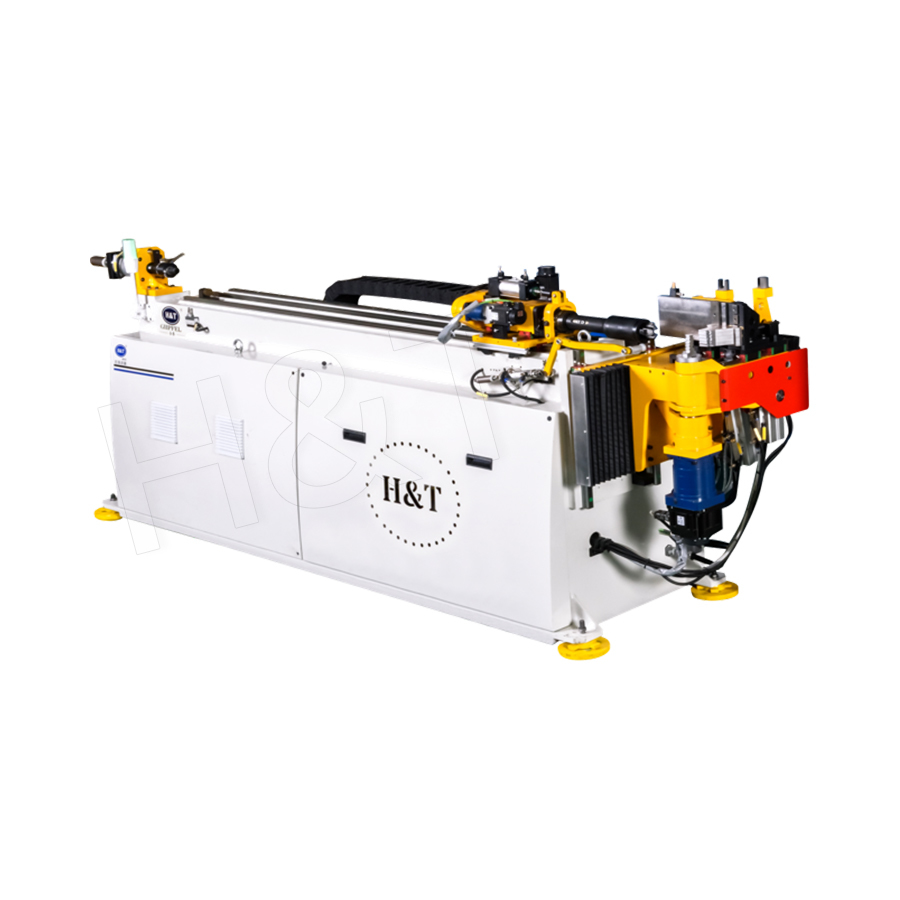
NC pipe bending machines consist of several key components: a bending die that forms the pipe to the desired radius, a clamp die that holds the pipe during bending, a pressure die that provides counter-pressure, and a wiper die that prevents wrinkling on the inside radius. The machine bed supports these components while the CNC system coordinates their movements. Hydraulic or servo-electric drive systems provide the force necessary to bend various pipe materials and diameters.

NC Bending Machine Types
Single-Head NC Bending Machines
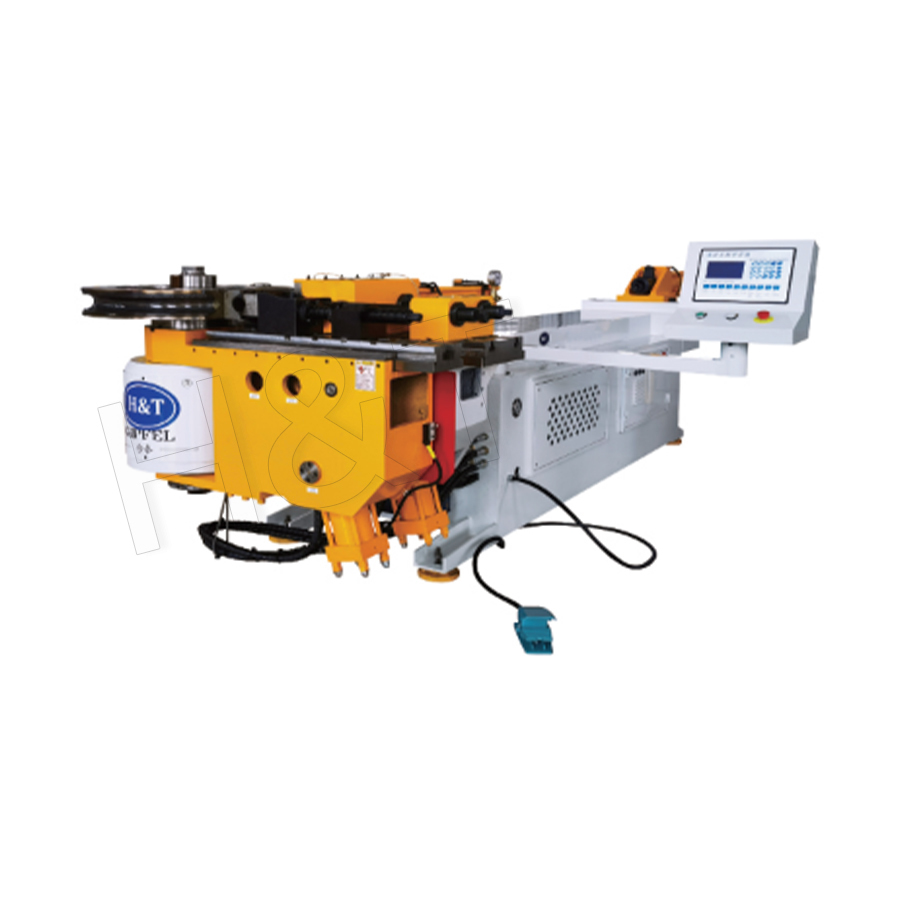
The NC single-head pipe bending machine is a high-precision machining equipment that winds and shapes pipes using a rotating die. Unlike multi-head models, its core feature is the single-head structure. This design makes the equipment more compact and lower in center of gravity, making it particularly suitable for precision machining scenarios with limited space or requiring high rigidity. Operators can directly input complex 3D pipe bending paths on the screen, and the system automatically calculates and executes them, achieving seamless machining from simple 2D to complex 3D pipe fittings.
Dual-Head NC Bending Machines
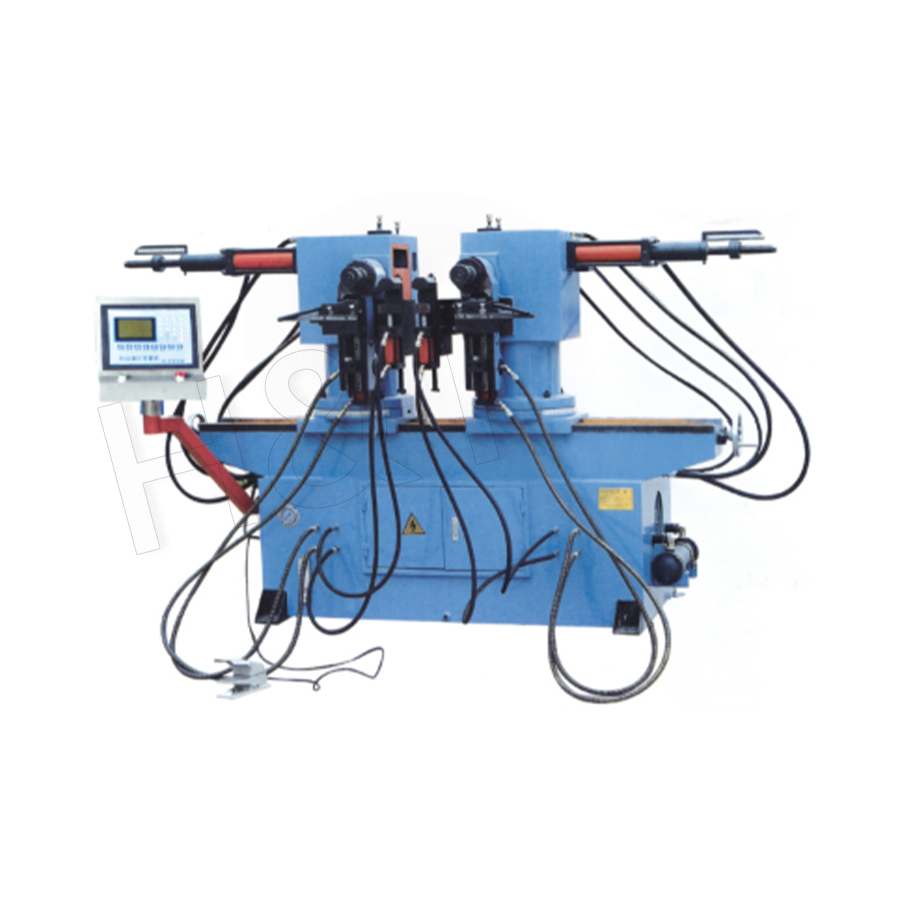
The dual-head CNC pipe bending machine represents a highly efficient tool in modern industrial pipe fitting processing. Its biggest breakthrough compared to traditional single-head machines lies in its dual-station synchronous operation capability. This equipment uses industrial-grade computer control combined with hydraulic or servo drive systems, enabling it to precisely bend two pipes simultaneously within a single work cycle. Whether processing automotive exhaust pipes, air conditioning condenser brackets, or complex bicycle frames, it can complete the processing with extremely high efficiency and precision.
The following table compares single-head and dual-head NC bending machines:
| Feature | Single-Head Machine | Dual-Head Machine |
|---|---|---|
| Productivity | One pipe per cycle | Two pipes per cycle |
| Machine size | Compact, lower center of gravity | Larger footprint |
| Best application | Precision, limited space | High-volume production |
| Complexity capability | 2D to complex 3D paths | Synchronized complex bends |
| Investment cost | Lower initial investment | Higher productivity return |
Advanced CNC Capabilities
Multi-Axis Linkage Control
Modern NC bending machines employ advanced CNC systems supporting multi-axis linkage control. This capability enables simultaneous coordination of multiple movement axes including bending arm rotation, carriage advance, and plane-of-bend rotation.
3D Pipe Bending Programming
Advanced NC bending systems allow operators to directly input complex 3D pipe bending paths on the screen, and the system automatically calculates and executes them. This programming capability achieves seamless machining from simple 2D bends to complex 3D pipe fittings with multiple bend directions and planes. The software simulates the bending process to detect potential collisions or interference before actual production, reducing scrap and setup time.
Industrial Applications
Automotive Manufacturing
NC bending is extensively used in automotive production for manufacturing exhaust systems, brake lines, fuel delivery systems, and structural components. The precision and repeatability of NC bending ensure that automotive pipe fittings meet strict quality standards and fit precisely during assembly. Complex exhaust configurations with multiple bends in different planes are efficiently produced using NC bending technology.
Aerospace and Medical Industries
In aerospace applications, NC bending produces precision tubing for hydraulic systems, fuel lines, and instrumentation with exacting tolerances. The medical industry utilizes NC bending for surgical instruments, medical device components, and hospital equipment frames where precision and cleanliness are paramount. These high-value applications demonstrate the capability of NC bending to meet the most demanding manufacturing requirements.
Furniture and Construction
NC bending serves the furniture industry for creating metal frames, chair bases, and decorative elements. In construction, it produces structural supports, handrails, and architectural features. The versatility of NC bending machines allows manufacturers to serve diverse markets with a single equipment investment.
Advantages of NC Bending
Precision and Consistency
NC bending delivers exceptional precision with bend angle tolerances typically within 0.1 degrees. This accuracy ensures that every part in a production run matches specifications exactly, eliminating the variation inherent in manual bending processes. Consistent quality reduces assembly issues and improves overall product performance.
Production Efficiency
Once programmed, NC bending machines operate automatically with minimal operator intervention. Setup times are reduced through stored programs, and cycle times are optimized through coordinated multi-axis movements. This efficiency translates to higher production rates and lower per-part costs compared to manual or semi-automatic bending methods.
Material Optimization
NC bending software calculates optimal bend sequences and tooling setups to minimize material waste. Precise control over bend parameters reduces scrap from over-bending, wrinkling, or collapse. The ability to simulate bending before production prevents costly mistakes and material loss.
Featured Products
A Complete Range of Tube Processing Solutions
Precision Tube Bending
 Ready To Customise
Your Bent Tube Products?

Ready To Customise Your Bent Tube Products?
Proprietary software, smart control systems, and 50+ patents ensure more efficient and intelligent production at every step.
Copyright © 2025 by Gipfel Precision Machinery Co.,Ltd All Rights Reserved. Privacy Precision Tube Machinery Manufacturer | Pipe Forming, Cutting, End Forming Solutions
