

 简体中文
简体中文 English
 日本語
日本語 한국어
한국어 Español
 русский
No. 196, Lifa Avenue, Haian City, Nantong, Jiangsu Province, China

News Category
Product Category
What Is CNC Bending? How Programmed Tube Bending and Press Brake Metal Bending Work
A 42 mm stainless exhaust tube with five bends, two of them in different planes, is not the same problem as a 90 degree bracket folded on a press brake. Both jobs are often described as CNC bending, but the machines, the tooling and the programming behind them are different. What they share is that every angle, distance and rotation comes from a stored program, not from an operator turning hard stops by hand.
The short answer is this. CNC bending is a metal forming process in which a computer numerical control system drives the machine axes, feeding the workpiece and setting bend angles to values taken from a part program. On a press brake that means ram depth, back gauge position and sometimes crowning. On a tube bender it means carriage feed, collet rotation and bend arm angle, moved by servo motors that can repeat the same position thousands of times with the same result.
Content
- 1 CNC Bending in Plain Terms
- 2 Sheet Bending and Tube Bending Are Two Different Jobs
- 3 How a CNC Bending Cycle Actually Runs
- 4 The Tooling That Decides Part Quality
- 5 What CNC Bending Improves, and Where It Stops Making Sense
- 6 Buying Checks Before You Specify a Machine
- 7 Common Problems and What They Usually Mean
- 8 Where CNC Bending Sits in a Production Line
CNC Bending in Plain Terms
CNC stands for computer numerical control, and the term describes how the machine is driven rather than what it does. An older NC bender is set by hand, with mechanical stops for feed length, a fixed rotation on the collet and a bend angle adjusted by a screw or dial. A CNC bender stores the same information as a program: axis positions, bend sequence, compensation values and tool data.
When the program runs, the controller sends a position command to each servo axis, reads feedback from the encoder and corrects the motion until commanded and actual positions match. That closed loop is why a CNC machine can hold an angle across a run of thousands of parts, and why a job that ran two years ago can be put back on the machine and produced from the same file.
Axis count is the practical measure of what a machine can do. A single head tube bender normally programs carriage feed, plane of bend rotation and bend angle. Add more tool stacks or a second bend head and the machine can produce multi plane and multi radius parts in one handling, which removes the re-clamping error that appears when a part moves between operations.
Sheet Bending and Tube Bending Are Two Different Jobs
Search results blend the two together, and that causes real specification mistakes. Press brake bending forms flat sheet over a punch and die, and the material is bent across its full width. Rotary draw tube bending pulls a tube around a bend die while a mandrel supports the inside of the wall. The failure modes, the tooling and the tolerance drivers are not the same, so an enquiry that only says CNC bending is often too vague to quote accurately.
| Aspect | CNC sheet bending on a press brake | CNC tube bending by rotary draw |
|---|---|---|
| Workpiece | Flat sheet and plate | Round, square or profile tube |
| Forming tool | Punch and V die | Bend die, clamp die, pressure die, mandrel |
| Programmed values | Ram depth, back gauge, bend sequence | Feed distance, rotation angle, bend angle |
| Main quality risk | Angle variation from springback and material batch | Ovality, wrinkling and wall thinning at the bend |
| Changeover | Tooling swap, program recall, first article check | Die set and mandrel change, program recall, first part check |
If the part is a flat panel with flanges, you are buying a press brake. If it is a tube that must carry fluid, gas or a cable, you are buying a tube bender, and the outside diameter, wall thickness and centerline radius will decide the tooling.
How a CNC Bending Cycle Actually Runs
- The part is defined in 3D or as a bend table: outside diameter, wall thickness, material, each bend angle, each centerline radius and the straight distance between bends.
- The bending program is created, either offline from the model or at the controller. Springback compensation, bend deduction and a collision check are applied at this stage.
- Tooling is prepared. The bend die, clamp die, pressure die and mandrel are matched to the tube size, and a wiper die is added where the wall is thin.
- A first article is bent and measured. Feed length, rotation and angle offsets are trimmed until the part matches the drawing.
- Production runs. The machine repeats the stored positions and the operator checks a sample at set intervals instead of adjusting every part.
- Parts move to the next operation, which may be end forming, chamfering, deburring or assembly.
The Tooling That Decides Part Quality
Two machines from the same builder can produce very different results because of tooling. The elements that matter most are:
- Mandrel. It supports the inside of the tube through the bend and controls ovality. A plug mandrel suits generous radii on thick walls, while a ball mandrel is usually needed for thin wall and tight radius work.
- Bend die. It sets the centerline radius and the groove shape, and in practice it also limits the maximum bend angle available at that radius.
- Clamp die. It grips the tube against the bend die and stops the material slipping backwards during the bend.
- Pressure die. It follows the tube and controls the outside wall, and it is often the difference between a clean surface and one covered in marks.
- Wiper die. It supports the inside of the bend where wrinkles start, which matters most on thin wall and small radius combinations.
- Lubrication. It reduces drag and heat and extends tool life, but the wrong lubricant leaves residue that must be removed before welding or plating.
What CNC Bending Improves, and Where It Stops Making Sense
Where the process earns its cost
- Consistency. The same program produces the same geometry on the first part and the thousandth part.
- Setup time. Program recall replaces manual re-setting of stops, so short batches become economical.
- Less operator dependence. Skill shifts from hand setting to programming, tooling selection and inspection.
- Multi bend parts in one cycle. Machine axes handle plane changes that would otherwise need two fixtures.
Where it does not fit
- Simple single angle parts in very low volume, where a manual or NC machine costs less per piece.
- A radius so tight relative to the wall that no mandrel configuration will hold the section.
- Thick plate forming, which belongs to press brake work rather than rotary draw bending.
Buying Checks Before You Specify a Machine
Most specification failures come from a short list of numbers that buyers leave out of the enquiry.
- Maximum outside diameter and wall thickness, since forming force scales with the wall section.
- Smallest centerline radius, usually described as a multiple of the tube diameter.
- Total number of bends and whether they sit in more than one plane.
- Required cycle time and whether loading and unloading must be automated.
- Material grade, because stainless and high strength steel spring back differently from mild steel.
For a single head machine, full servo control is the configuration to look for, with feed, rotation and bend angle all driven by the program rather than by mechanical stops.
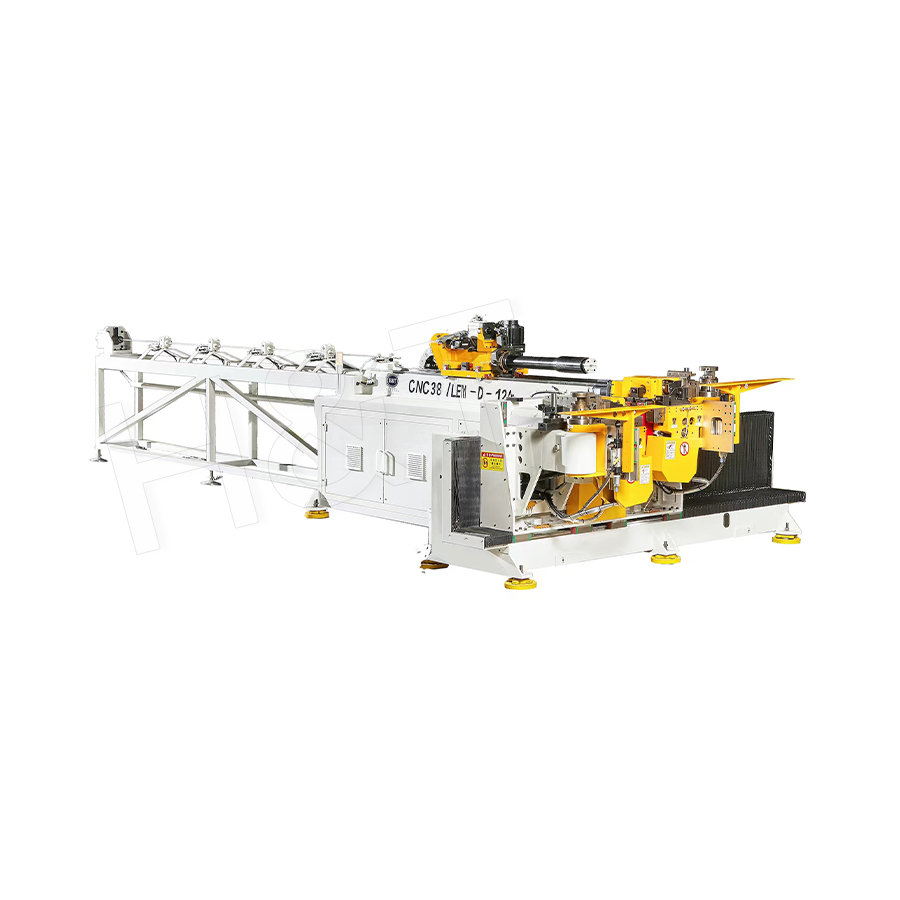
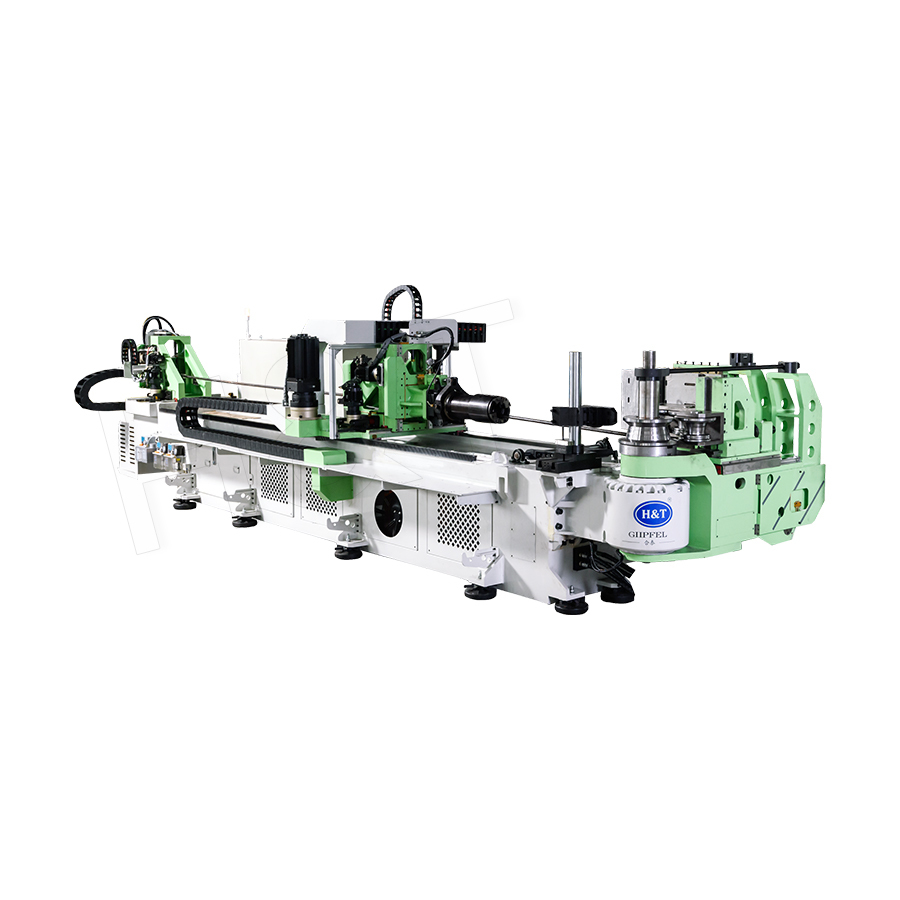 Single Direction Full-servoThe unidirectional all-electric pipe bending machine is the core product of H T's E-series. Utilizing all-electric drive technology, it achieves high-precision unidire...View Product →
When a part has bends on both sides of the tube, or needs two bends formed at once, a double head machine shortens the cycle and removes a second handling step.
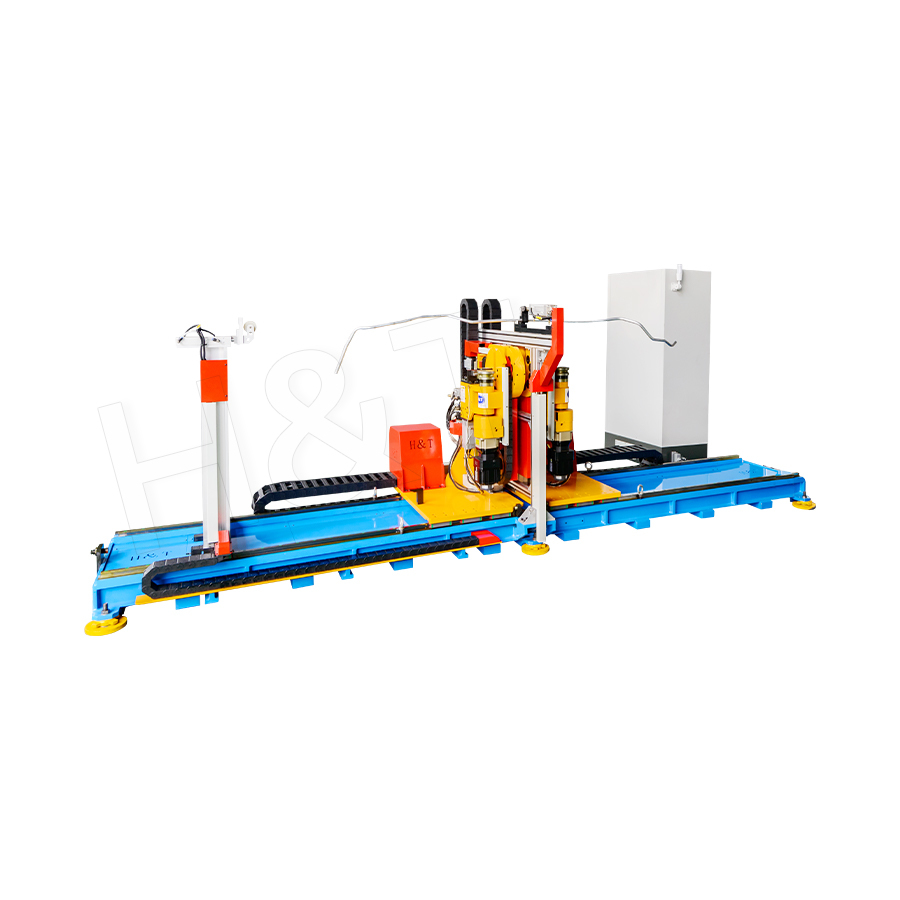
 3D Double-head Full-servo BendingThe 3D Double-head Full-servo Bending is a high-precision automated processing equipment developed by Hetai specifically for ultra-long and ultra-fine pipes in the aut...View Product →
Large diameter and heavy wall tube needs more torque and a stiffer frame, because the forming force rises quickly with wall section and radius.
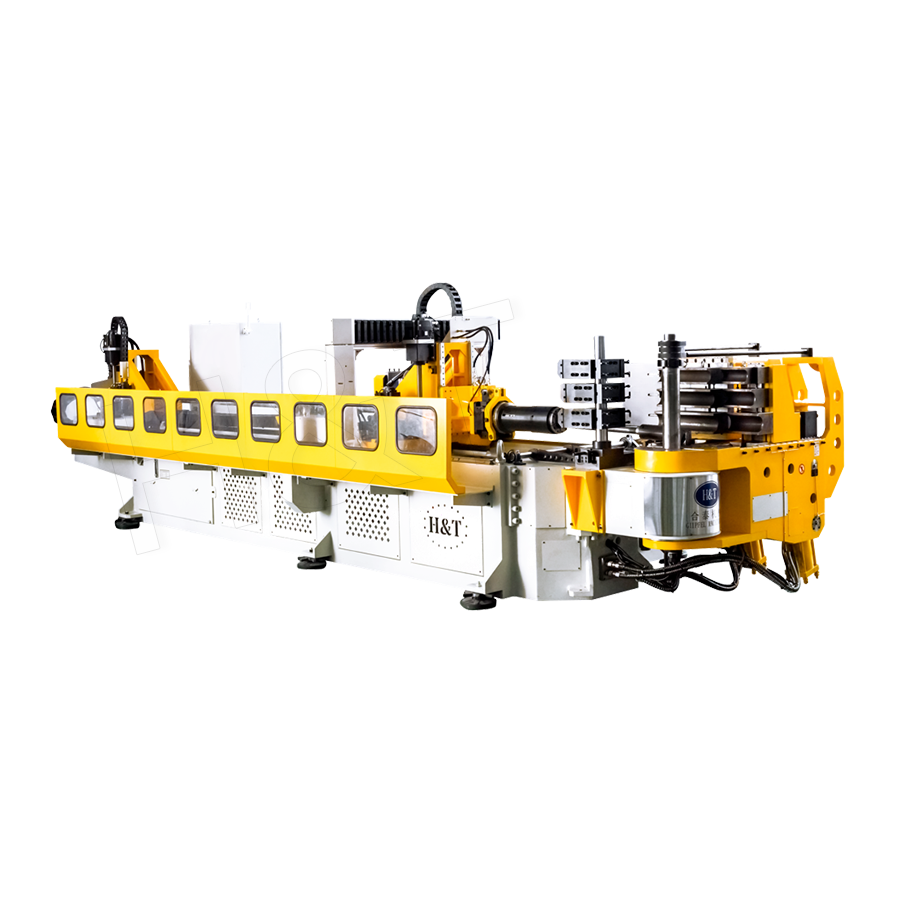 Heavy Duty tube bending machineThe heavy duty tube bending machine, model CNC65×E-9A, is a heavy-duty pipe forming equipment specifically developed for high-tech-intensive industries such as aviatio...View Product →
Common Problems and What They Usually Mean
- Ovality above the drawing limit. The mandrel is too small, the wrong mandrel type is fitted, or the radius is too tight for the wall thickness.
- Wrinkles on the inside of the bend. A wiper die is missing or badly positioned, or the wall has too little support.
- Angle drift during a run. Springback varies between material batches, or the clamp die is slipping and pulling material.
- Scratches along the outside radius. Pressure die setting, tool clearance or lubrication needs review.
- Flattening at the start of the bend. Clamp length is too short, or the clamp die groove does not match the tube.
Where CNC Bending Sits in a Production Line
Bending is rarely a standalone operation. A typical tube line cuts stock to length, chamfers and deburrs the ends, bends the part, then forms or flares the tube ends. Linking those steps changes the economics of the job, because parts stop waiting between machines and handling damage falls. That is why many buyers now specify the bending machine as part of a wider automation line rather than as an isolated purchase.
CNC bending is not a single machine type. It is a method of controlling a bending machine so that the geometry comes from a program instead of from an operator's hands. If you know the outside diameter, wall thickness, material grade, the smallest centerline radius and the number of bends in different planes, you already hold the five numbers a machine builder needs to quote properly.
If you would like those numbers reviewed against a real configuration before you commit to tooling, you can contact the team and share the part drawing with the bend table.
Featured Products
A Complete Range of Tube Processing Solutions
Precision Tube Bending
 Ready To Customise
Your Bent Tube Products?

Ready To Customise Your Bent Tube Products?
Proprietary software, smart control systems, and 50+ patents ensure more efficient and intelligent production at every step.
Copyright © 2025 by Gipfel Precision Machinery Co.,Ltd All Rights Reserved. Privacy Precision Tube Machinery Manufacturer | Pipe Forming, Cutting, End Forming Solutions
