

 简体中文
简体中文 English
 日本語
日本語 한국어
한국어 Español
 русский
No. 196, Lifa Avenue, Haian City, Nantong, Jiangsu Province, China

News Category
Product Category
Comprehensive Guide to CNC Tube Bending Machine Manufacturers
Choosing the right manufacturer for a CNC Bending machine requires evaluating technical capability, software architecture, tooling system flexibility, after-sales support depth, and total cost of ownership — not just the machine's price tag or country of origin. The global CNC tube bending machine market is led by manufacturers from Italy, Germany, Japan, Taiwan, and China, each with distinct strengths in precision grade, automation level, and price-to-performance ratio. This guide covers what differentiates manufacturers, the specifications that matter most for different production environments, and the evaluation criteria that experienced procurement engineers use to distinguish a long-term productive investment from a machine that underdelivers in production. Whether you are sourcing a machine for automotive exhaust systems, HVAC pipework, aerospace tubing, or structural fabrication, the framework in this guide applies directly to your buying decision.
Content
- 1 What Is a CNC Tube Bending Machine and Why Manufacturer Choice Matters
- 2 Key Technical Specifications That Define Machine Capability
- 3 CNC Controller Architecture: The Most Consequential Manufacturer Decision
- 4 Tooling Systems: Where Hidden Cost and Flexibility Reside
- 5 Manufacturer Regions and Their Characteristic Strengths
- 6 Applications: Matching Machine Type to Industry Requirements
- 7 Evaluating After-Sales Support: The Most Underweighted Selection Factor
- 8 What to Ask Manufacturers Before Purchasing
- 9 Total Cost of Ownership: The Correct Basis for Manufacturer Comparison
- 10 Energy Efficiency: All-Electric vs. Hydraulic CNC Benders
- 11 Industry 4.0 Integration: What Modern Manufacturers Offer
- 12 Selecting the Right CNC Bending Machine: A Practical Decision Framework
What Is a CNC Tube Bending Machine and Why Manufacturer Choice Matters
A CNC tube bending machine uses computer-controlled servo axes to bend metal tube, pipe, or profile to precise angles, radii, and spatial orientations — forming complex three-dimensional shapes from straight stock material in a single automatic sequence. The machine controls the rotation of the bend die, the feed distance of the tube between bends, and the rotational orientation of the tube around its own axis, producing multi-plane bent components with repeatable accuracy measured in fractions of a degree.
The manufacturer's influence on machine performance extends well beyond the structural frame. The CNC controller architecture, servo drive selection, tooling interface design, software offline programming capability, and long-term spare parts availability are all manufacturer-determined factors that affect the machine's daily productivity, its ability to process new part programs without machine downtime, and its total productive life. A frame that outlasts its control system by a decade is a common failure mode of purchasing decisions made on initial price alone.
The global CNC tube bending machine market was valued at USD 1.24 billion in 2022 and is projected to reach USD 1.87 billion by 2030, growing at a CAGR of 5.3%, driven by automotive lightweighting programs, HVAC infrastructure expansion in emerging markets, and aerospace manufacturing growth. (Source: MarketsandMarkets, CNC Tube Bending Machine Market, Global Forecast to 2030, 2023)
Key Technical Specifications That Define Machine Capability
Before evaluating specific manufacturers, understanding the technical specifications that determine whether a CNC Bending machine is suited to your production requirements is essential. These are the specifications that matter most in practice:
Maximum Tube Diameter and Wall Thickness
The machine's maximum tube capacity — stated as outside diameter (OD) in mm — defines the upper boundary of material it can process. However, maximum OD alone is insufficient as a specification: the maximum OD at the machine's minimum wall thickness ratio (D/t ratio) is equally important. A machine rated for 76 mm OD maximum may only achieve this at a 3 mm wall thickness, and may not be able to bend thin-walled 76 mm tube at a tight radius without wall thinning, wrinkling, or ovalization beyond the tolerance limits of the application.
As a practical guideline, the minimum achievable bend radius for standard rotary draw bending is approximately 1.0 to 1.5 times the tube outside diameter (1D to 1.5D) for medium-wall-thickness tube in mild steel, with tight-radius capability below 1D requiring dedicated boost and wiper die systems that should be confirmed with the specific manufacturer for the intended material and wall thickness combination. (Source: Machinery's Handbook, Bending of Tube and Pipe, 31st Edition, Industrial Press, 2020)
Number of Controlled Axes
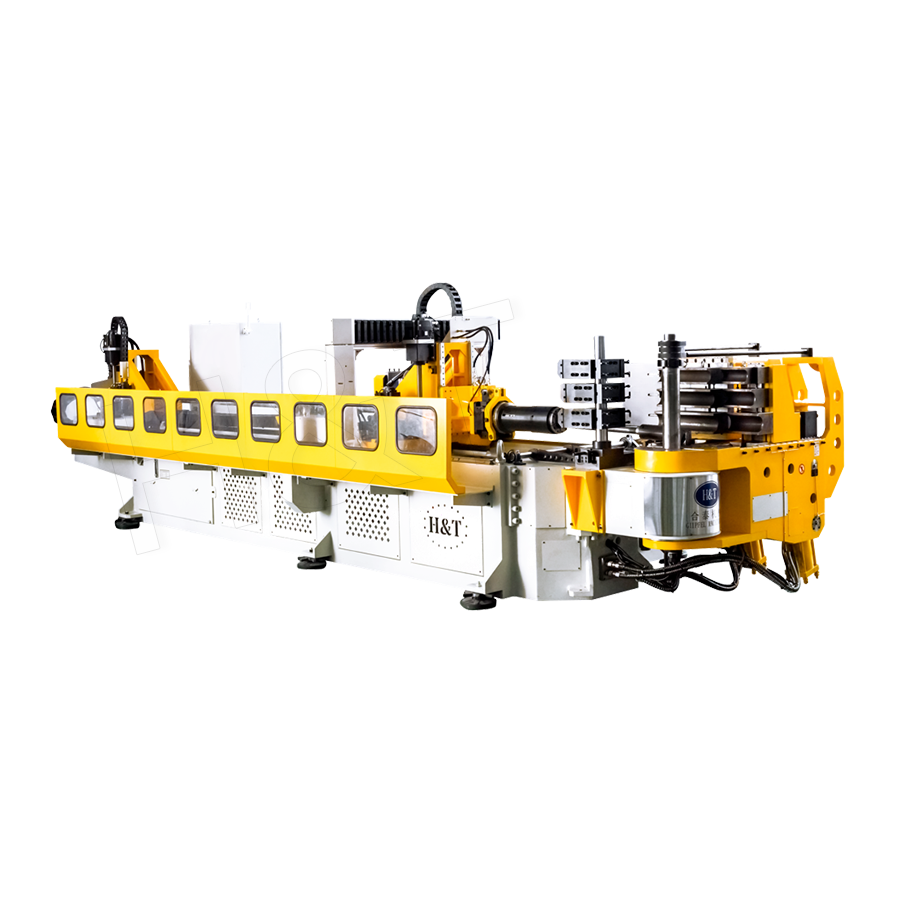
The number of independently controlled CNC axes determines the machine's ability to produce multi-plane bent parts and automate auxiliary functions. A basic 3-axis machine controls bend angle (B), carriage feed (Y), and tube rotation (C). A fully equipped machine for complex aerospace or automotive parts may have 7 to 12 controlled axes, including:
- B axis: Bend die rotation (primary bending axis)
- Y axis: Linear carriage feed (sets straight length between bends)
- C axis: Tube rotation (sets bend plane orientation for multi-plane parts)
- Pressure die assist (P axis): Controlled forward push on the pressure die to reduce wall thinning on tight radius bends
- Boost axis: Controlled tube end push during bending to increase material flow into the bend and reduce thinning
- Wiper die retract axis: Servo-controlled wiper die positioning for thin-wall bending
- Mandrel extraction axis: Synchronized mandrel ball pull-back during bending for internal support
Bend Speed and Cycle Time
Bend speed — measured in degrees per second — directly determines the productive output of the machine in high-volume production. Industrial CNC tube benders for automotive production operate at 60 to 120 degrees per second on the B axis, with total cycle times for a multi-bend automotive exhaust component (6 to 8 bends) in the range of 15 to 30 seconds per part including tube feed and rotation time between bends. Precision aerospace CNC benders for titanium or Inconel alloys operate at lower bend speeds to control springback consistency, typically 20 to 40 degrees per second. (Source: The Tube and Pipe Journal, CNC Bending Speed vs. Quality Trade-offs, Vol. 14, No. 3, 2019)
Springback Compensation
Metal tube springs back elastically after the bend die releases, reducing the actual bent angle below the programmed angle. Springback varies with material grade, wall thickness, tube diameter, and bend radius. Advanced CNC bending controllers include automatic springback compensation algorithms that measure actual angle after release (via encoder feedback), calculate the required overbend, and update the B-axis target for subsequent bends automatically. Manufacturers whose controllers include adaptive springback learning — where the system refines the compensation value over a production run rather than using a fixed calculated offset — produce more consistent part accuracy across full production batches, particularly when processing variable-property material from different coils.
CNC Controller Architecture: The Most Consequential Manufacturer Decision
The CNC controller is the intellectual core of a tube bending machine. It is also the component most likely to determine the machine's productive life and its ability to adapt to new requirements over a 15 to 20 year operational period. Controller quality varies more between manufacturers than any other component of the machine.
Proprietary vs. Open-Platform Controllers
Manufacturers use either proprietary controllers developed specifically for tube bending, or open-platform industrial CNC systems (Siemens, Fanuc, Beckhoff, or equivalent) with tube bending application software layered on top. Each approach has distinct advantages and risks:
| Controller Type | Advantages | Risks and Limitations | Best Suited For |
|---|---|---|---|
| Proprietary machine-specific controller | Optimized for tube bending; often simpler operator interface; tightly integrated with machine axes | Manufacturer-dependent for software updates; spare parts risk if manufacturer discontinues; limited third-party integration | Single-application high-volume production; stable product range |
| Open-platform (Siemens, Fanuc, etc.) with tube bending software | Long-term spare parts availability from major suppliers; broad technical service network; software upgradeable independently | Higher initial cost; potentially more complex interface; application software quality varies by integrator | Flexible production environments; integration with factory automation; long service life requirement |
Offline Programming and Simulation
The ability to program new part geometries offline — on a PC, away from the machine — and simulate the bending sequence before the first physical tube is run is one of the most productive features a CNC bending system can offer. Without offline programming, new part setup requires machine downtime while the programmer creates and proves out the part program at the machine. With offline programming integrated with 3D simulation:
- New part programs are developed while the machine is running current production, with zero machine downtime for programming
- Collision detection in the simulation identifies clashes between the tube, tooling, and machine structure before any physical trial, saving material waste from first-off tryouts
- Bending sequence optimization — selecting the order in which bends are made to minimize collision risk — is automated by the software rather than requiring experienced operator judgment
- Direct import of 3D CAD data (STEP, IGES, or native format) allows the part program to be derived from the design model without manual angle and length extraction, eliminating transcription errors
Manufacturers who provide genuinely capable offline programming software — not a simplified interface that still requires significant machine-side adjustments — deliver a measurable productivity advantage that compounds across the machine's service life as the variety of parts processed increases. Request a demonstration of offline programming on a part similar to your most complex production component before finalizing a machine purchase.
Tooling Systems: Where Hidden Cost and Flexibility Reside
The tooling system — bend dies, clamp dies, pressure dies, wiper dies, and mandrel bars — represents a substantial portion of the total investment in a CNC Bending operation and significantly affects the machine's flexibility to process different tube sizes and radii. Tooling decisions are often underweighted in the initial machine purchase and become the source of unexpected cost and production constraint in the years following installation.
Tooling Compatibility and Standardization
Machines that use standardized tooling interfaces allow tooling from multiple suppliers to be used interchangeably, providing competitive sourcing options and preventing supplier lock-in. Machines with proprietary tooling interfaces limit the buyer to a single source for all future tooling requirements — a risk that increases as the tooling investment grows over the machine's productive life.
Before purchasing, confirm whether the machine's tooling interface dimensions conform to any widely used standard and whether tooling from multiple manufacturers has been tested and approved by the machine builder. For operations processing a wide range of tube sizes, the cost of a complete tooling set for each diameter-radius combination can equal or exceed the cost of the machine itself over a 5-year operating period, making the tooling cost model as important as the machine purchase price. (Source: The Tube and Pipe Journal, Total Cost of Ownership in CNC Tube Bending, Vol. 16, No. 1, 2021)
Quick-Change Tooling Systems
Production operations that process multiple tube sizes in short runs benefit significantly from quick-change tooling systems that minimize the machine downtime required for tooling changeover between different tube diameters or bend radii. Leading manufacturers offer tooling change systems that reduce changeover time from 60 to 90 minutes for manual tooling exchange to 10 to 15 minutes with quick-change systems, directly improving machine utilization in mixed-product production schedules. The financial justification for quick-change tooling — calculated against the hourly machine rate and the number of changeovers per week — typically pays back the premium within 6 to 18 months in operations with more than three to four tooling changes per day.
Multi-Radius Tooling and Stacked Tooling
Advanced machines from leading manufacturers support multi-radius tooling configurations — where multiple bend die radii are stacked on a common mandrel or mounted on a turret — allowing different radius bends to be made on the same tube without a tooling change. This capability is critical for parts requiring bends at two or more different radii, which would otherwise require either two separate machines or a tooling changeover between bends on a single machine. Turret tube benders — a specialized configuration from specific manufacturers — take this concept further, with 4 to 8 different tooling sets on a rotating turret that can be indexed between bends within the machine's automatic cycle.
Manufacturer Regions and Their Characteristic Strengths
Understanding the manufacturing tradition and typical market positioning of manufacturers from different regions helps buyers match their requirement to the most appropriate supply source:
| Region | Typical Strengths | Typical Limitations | Best-Fit Applications |
|---|---|---|---|
| Italy | High precision; advanced automation; strong aerospace and automotive tier-1 reference base; comprehensive software capability | Higher initial cost; longer lead time for customization; service response time outside Europe | Aerospace, automotive tier-1, medical device, high-mix precision production |
| Germany | Engineering rigor; long machine life; Siemens/Beckhoff control integration; strong European automotive supply chain presence | Premium pricing; limited flexibility on non-standard configurations | Automotive production lines; high-volume precision bending; integration with German OEM supply chains |
| Japan | Precision assembly quality; servo system excellence; compact design for restricted floor space | Limited English documentation and support outside Asia; customization may be limited | Electronics and precision instrument tubing; compact production cells; Asian automotive supply chains |
| Taiwan | Strong price-performance ratio; good controller options (Siemens or native); responsive to custom requirements | Variable quality between manufacturers; after-sales service quality varies | Medium-precision production; HVAC; automotive aftermarket; cost-sensitive applications |
| China | Lowest initial cost; improving quality and software capability; rapid delivery; broad range of configurations available | Wide quality variation between manufacturers; after-sales service varies; documentation quality varies | High-volume lower-precision production; domestic China market; price-driven procurement |
Applications: Matching Machine Type to Industry Requirements
Different industrial applications impose different requirements on CNC tube bending machines. Understanding which machine features matter most for each application guides the manufacturer evaluation toward the relevant specification priorities:
Automotive Exhaust and Chassis Systems
Automotive exhaust and chassis tube bending is characterized by high production volumes, consistent material from controlled supply chains, and dimensional tolerances in the range of plus or minus 0.5 to 1.0 degrees on bend angle and plus or minus 0.5 mm on straight length. The production priority is cycle time minimization and machine uptime — a single exhaust line producing 1,000 units per shift cannot tolerate frequent machine stops for parameter adjustment. Manufacturers supplying automotive production typically offer machines with integrated tube loading automation, end-forming integration, and in-cycle measurement systems that maintain output without human intervention.
Aerospace Tubing and Hydraulic Lines
Aerospace tubing applications — hydraulic lines, fuel system tubes, pneumatic manifolds — demand dimensional tolerances an order of magnitude tighter than automotive production: plus or minus 0.1 to 0.3 degrees on bend angle and plus or minus 0.2 mm on straight length are typical aerospace part tolerances. Materials include titanium, stainless steel grades, and nickel alloys that springback differently from mild steel and require precise material characterization and springback compensation. Manufacturers targeting aerospace typically offer CE-certified machines with comprehensive process documentation capability, material batch tracking integration, and first-article inspection support.
HVAC and Refrigeration Pipework
HVAC tube bending — primarily copper and aluminum tube in diameters from 6 mm to 54 mm — requires machines optimized for non-ferrous material processing at relatively high production rates. The tubes are typically thin-walled relative to their diameter, requiring careful ovalization and thinning control. HVAC manufacturers prioritize tube bender speed, ease of operator use, and low tooling cost per diameter increment rather than the tight angular precision required in aerospace applications. Right-angle bends at fixed radii in a limited number of tube sizes characterize most HVAC production, making the machine's ability to handle changeovers quickly between the same limited tooling set more important than full multi-radius flexibility.
Structural and Architectural Tubing
Structural tube bending for architectural and construction applications involves larger diameter tube and profile sections — round, square, and rectangular hollow sections — at bending radii that are large relative to the tube diameter (typically 5D to 15D), which reduces tooling and wrinkling concerns but introduces the challenge of accurately predicting and compensating for the large springback values characteristic of high-radius bends in structural grade steel. Manufacturers specializing in structural bending emphasize machine rigidity, tonnage capacity, and long-radius tooling systems rather than the speed and precision of automotive or aerospace-oriented machines.
Evaluating After-Sales Support: The Most Underweighted Selection Factor
A CNC tube bending machine that stops during a production run is not a neutral event — it is a negative revenue event that may carry contractual penalties, customer satisfaction consequences, and labor cost from idle downstream assembly. The machine's after-sales support capability is therefore a direct factor in its total productive value, not merely a purchasing convenience.
Service Response Time Commitments
Evaluate each manufacturer's committed service response time — the time from a service call to a qualified technician on-site or providing remote resolution — for your production location. A machine manufactured in Europe with no regional service presence in Southeast Asia may have a 5 to 7 day on-site response time that is unacceptable for a 24-hour production operation, regardless of how capable the machine is in normal production. Request specific service response commitments in writing — not general descriptions of "global service networks" — and verify these commitments against references from customers in your region before purchasing.
Spare Parts Availability and Strategic Stocking
Critical spare parts — servo drives, CNC controller boards, bend die rotation motor assemblies, and axis feedback encoders — should be available from either the manufacturer's regional warehouse or a local distributor within 24 to 48 hours for a production-critical machine. Request the manufacturer's spare parts availability commitment and assess whether they maintain a regional parts depot near your facility. For machines using standard controller hardware (Siemens, Fanuc), the availability of controller components through the automation supplier's distribution network provides a useful backup supply path that proprietary controller users do not have.
Remote Diagnostics and Connectivity
Modern CNC tube bending machines from leading manufacturers include secure remote diagnostic capability — a VPN connection through which the manufacturer's service engineers can view machine status, alarm history, axis performance data, and program execution in real time from their office without traveling to the machine location. This capability allows many fault conditions to be diagnosed and resolved — or at least characterized accurately enough to dispatch the correct parts and skills — within hours of an alarm, rather than after a site visit. When evaluating manufacturers, confirm the remote diagnostic capability and the actual use of this capability by reference customers, not just its availability on a specification sheet.
What to Ask Manufacturers Before Purchasing
A structured set of questions to each manufacturer candidate during the evaluation process produces comparable responses that reveal capability gaps and service quality differences that a specification sheet comparison misses:
- Can you provide bend test results on my specific tube material, OD, wall thickness, and target radius? A manufacturer who cannot or will not conduct a bending trial on your actual material before purchase is not providing the evidence base needed to confirm the machine will meet your production requirements
- What is the committed service response time for on-site support at my production location? This should be a specific time in hours, not a general assurance. Verify against references from customers in your geographic region
- What is the controller replacement or upgrade path if the current CNC hardware is discontinued? The answer reveals whether the manufacturer has a long-term plan for the machine's control system or whether purchasing this machine creates obsolescence risk within 5 to 8 years
- What offline programming software is included, and can I see it demonstrated on a part similar to my most complex production component? A demonstration on your specific part geometry reveals capability honestly rather than on a pre-prepared demonstration part designed to showcase the software's best case
- What is the tooling interface specification and which third-party tooling suppliers have been validated for this machine? Confirms whether competitive sourcing for future tooling is possible or whether single-source dependency is created
- What is the machine's stated accuracy specification and how is this verified during acceptance testing? Accuracy should be specified as a measurable value (degrees and mm) with a defined measurement method, not as a qualitative description of "high precision"
- What is the warranty coverage and what does it exclude? Confirm specific exclusions — particularly consumable tooling, seals, and software licenses — that may create unexpected costs during the warranty period
Total Cost of Ownership: The Correct Basis for Manufacturer Comparison
The lowest purchase price does not represent the lowest cost of ownership over the machine's productive life. A rigorous total cost of ownership (TCO) comparison between manufacturer candidates should include:
| Cost Element | Description | Typical Range (10-Year Horizon) |
|---|---|---|
| Purchase price | Machine, installation, commissioning, initial tooling set | Baseline (100%) |
| Tooling cost | Bend dies, pressure dies, mandrel systems for full product range over 10 years | 50 to 150% of machine purchase price |
| Maintenance and spare parts | Preventive maintenance, unplanned repairs, controller components | 15 to 30% of machine purchase price |
| Unplanned downtime cost | Lost production during machine stoppages, weighted by response time | Highly variable; 5 to 40% of machine purchase price |
| Training and programming | Operator training, program development labor, offline software licenses | 5 to 15% of machine purchase price |
| Energy consumption | Electrical consumption difference between servo-driven and hydraulic machines | 5 to 20% of machine purchase price over 10 years |
(Source: The Tube and Pipe Journal, Total Cost of Ownership in CNC Tube Bending, Vol. 16, No. 1, 2021)
The TCO framework consistently shows that a machine with a 20 to 30% higher purchase price but superior service response, better offline programming capability, and standardized tooling compatibility will have a lower 10-year total cost than a lower-priced machine with high downtime costs, proprietary tooling lock-in, and limited controller support life.
Energy Efficiency: All-Electric vs. Hydraulic CNC Benders
The transition from hydraulic to all-electric servo CNC tube bending machines is one of the most significant technology shifts in the industry over the past decade and is a factor that distinguishes forward-looking manufacturers from those who continue to rely on hydraulic drive systems.
All-electric CNC benders — where every machine axis is driven by a servo motor rather than hydraulic cylinders and pumps — provide measurable advantages over equivalent hydraulic machines:
- Energy consumption reduction of 40 to 70%: Servo motors consume energy only when moving, while hydraulic pumps run continuously whether or not the machine is actively bending. In a machine operating at 40% duty cycle during a shift, the continuous hydraulic pump power represents significant unnecessary energy consumption. (Source: Rexnord Energy Study, Hydraulic vs. Electric Servo Actuator Energy Comparison, 2018)
- Elimination of hydraulic fluid maintenance: All-electric machines eliminate the ongoing cost and environmental risk of hydraulic oil — changes, filtration, leak cleanup, and disposal — which typically represent 3 to 5% of annual maintenance cost on hydraulic tube benders
- Higher axis positioning repeatability: Servo motor direct-drive positioning eliminates the thermal drift of hydraulic systems as fluid temperature changes during the shift, improving dimensional consistency of bent parts across a full production shift without recalibration
- Lower noise level: All-electric machines operate at 60 to 70 dB compared to 75 to 85 dB for comparable hydraulic machines — a workplace health benefit that also improves the production environment quality for nearby operations
Industry 4.0 Integration: What Modern Manufacturers Offer
CNC tube bending machines from leading manufacturers are increasingly designed with connectivity and data output capability that supports integration into Industry 4.0 production environments — where machine data flows to MES (Manufacturing Execution Systems), ERP systems, and quality management platforms in real time.
Specific capabilities to evaluate include:
- OPC-UA connectivity: The industry-standard machine communication protocol for Industry 4.0 environments allows the machine's production data — cycle counts, axis performance, alarm history, and process parameters — to flow to higher-level factory systems without custom integration code
- Part traceability data output: Machines with per-part process data recording — capturing the actual bend angle, feed length, rotation, and boost force for every individual bend on every part produced — provide the data foundation for statistical process control and regulatory traceability requirements in automotive and aerospace applications
- Predictive maintenance data: Servo drive current monitoring and axis position error tracking provide early indicators of mechanical wear — increasing friction in a guide rail, wear in a ball screw, or bearing degradation in a servo motor — that allow maintenance intervention before a production-stopping failure occurs
- Automated cell integration: Machines with standardized robot interface protocols (KUKA.WorkVisual, Fanuc Robot Interface, or equivalent) allow integration with tube loading robots, vision inspection systems, and downstream assembly automation without machine-specific custom programming for each integration
Selecting the Right CNC Bending Machine: A Practical Decision Framework
The following decision framework sequences the evaluation steps in the order that most efficiently eliminates unsuitable options and focuses the detailed evaluation on candidates that genuinely match the production requirement:
- Define the tube specification range. List all OD, wall thickness, material grades, and minimum bend radii currently in production and planned for the next 5 years. Any machine that cannot process the full range — including planned future work — fails at this first filter regardless of its other attributes
- Determine production volume and cycle time requirement. Calculate the parts per shift required and the maximum allowable cycle time per part at the planned production rate. This eliminates machines whose bend speed is insufficient for the target throughput
- Assess complexity level of parts. Count the number of bends per part, the number of different bend planes, and whether any multi-radius bends are required. This determines whether a 3-axis machine suffices or whether 5, 7, or more controlled axes are required
- Evaluate controller and software against production programming workflow. Assess how new part programs will be created, proven, and updated — and whether the machine's offline programming software genuinely supports this workflow or requires time-consuming machine-side development
- Conduct a bending trial on representative production material. Any manufacturer who cannot or will not demonstrate the machine bending your actual material to your actual specification before purchase is not providing an adequate evidence base for a capital investment decision
- Verify after-sales support capability in your region. Contact the manufacturer's regional service manager directly and obtain specific commitments on response time, parts availability, and remote diagnostic capability before contract signature
- Compare 10-year TCO, not purchase price. Build the total cost model for each finalist using the framework above before finalizing the selection. The highest purchase price option may be the lowest 10-year cost option depending on service, tooling, and downtime differentials
The TubeBendingMachinery CNC Bending machine range is designed to meet the full set of evaluation criteria described in this guide — covering tube diameters from small-bore precision applications through large structural profiles, with all-electric servo axis configurations, offline programming software with 3D simulation, standardized tooling interfaces, and regional after-sales service support. Their product range serves applications from automotive tier-1 exhaust production through HVAC pipework, structural fabrication, and precision aerospace tubing, with configurations scalable from entry-level CNC bending for low-volume work through fully automated production cells with integrated loading, vision inspection, and MES connectivity.
Featured Products
A Complete Range of Tube Processing Solutions
Precision Tube Bending
 Ready To Customise
Your Bent Tube Products?

Ready To Customise Your Bent Tube Products?
Proprietary software, smart control systems, and 50+ patents ensure more efficient and intelligent production at every step.
Copyright © 2025 by Gipfel Precision Machinery Co.,Ltd All Rights Reserved. Privacy Precision Tube Machinery Manufacturer | Pipe Forming, Cutting, End Forming Solutions
